



Last Updated: October 23, 2026
Quick Summary
Sustainable alpaca wool sourcing means verifying animal welfare, traceability, processing methods, and community impact across the entire supply chain, not just trusting a hangtag. Ask suppliers for farm IDs, scope and transaction certificates, processing records, and dye declarations, because a claim you cannot trace is a claim you cannot check.
- The global alpaca fiber market was estimated at USD 3.72 billion in 2025 and is projected to reach USD 3.94 billion in 2026.
- Traceability breaks at handoffs, so confirm where farm-level identity is lost when fleece is pooled.
- The Responsible Alpaca Standard covers sites from farms through the final business-to-business seller and is audited, not self-declared.
- Scouring is the most water-intensive early processing stage, so ask how wastewater is treated and whether wash water is recycled.
- Hand wash alpaca in cold water or dry clean, lay flat to air dry, and store folded rather than hung.
Table of Contents
- Why Sustainable Alpaca Wool Sourcing Is Harder Than It Looks
- Alpaca Fiber Traceability: Following Fleece From Farm to Garment
- Alpaca Wool Environmental Impact: What the Evidence Supports
- Animal Welfare and Shearing: What Responsible Farms Do Differently
- Processing, Dyeing, and the Hidden Stages of Fiber Production
- Alpaca Wool Supplier Questions to Ask Before You Buy
- Alpaca Clothing Care: Making a Sourced Garment Last
- Frequently Asked Questions
Why Sustainable Alpaca Wool Sourcing Is Harder Than It Looks
The global alpaca fiber market was estimated at USD 3.72 billion in 2025 and is projected to reach USD 3.94 billion in 2026, according to 360iResearch's alpaca fiber market analysis. At Purely Alpaca, we've watched that growth bring a flood of "eco" labels that mean very little. For a broader ethical luxury fashion context to frame the challenge, see our ethical luxury fashion guide for winter.
What the Market Numbers Say
Growth attracts shortcuts. A separate Strategic Market Research alpaca fiber report valuation put the market near USD 3.9 billion in 2024 with a projected 6.8% compound annual growth rate. More money in the category means more middlemen between farm and garment, and every handoff is a place where claims get blurry.
Alpaca Fiber Traceability: Following Fleece From Farm to Garment
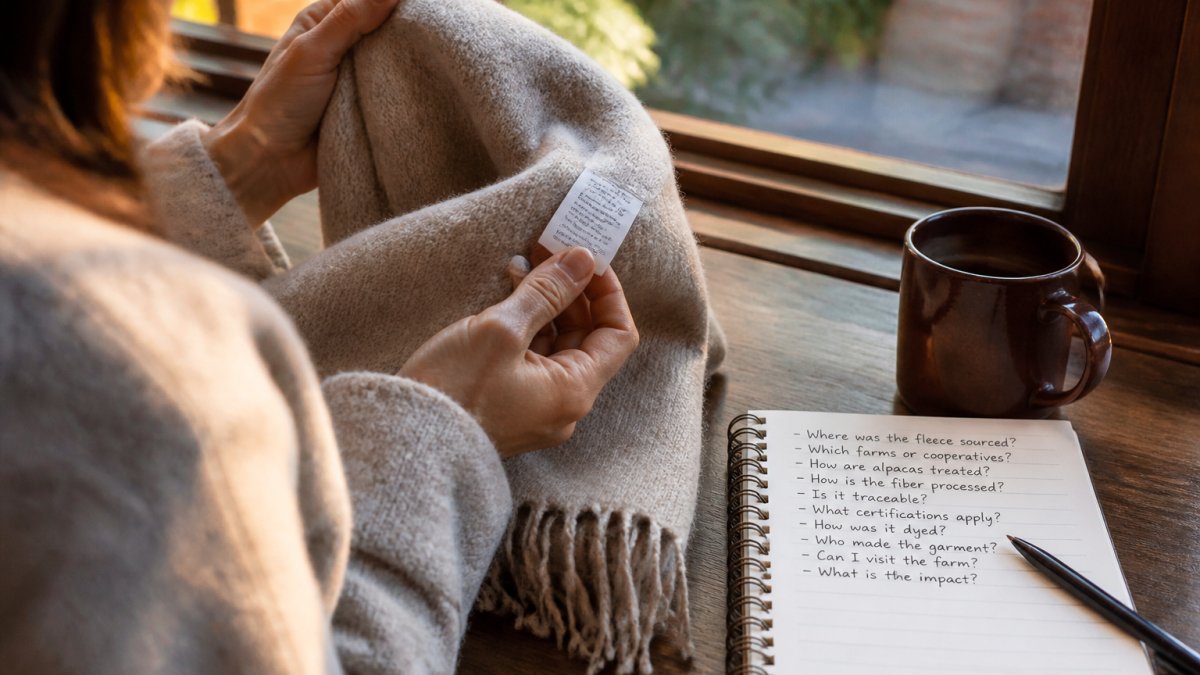
Alpaca fiber traceability is the documented ability to follow fleece from a specific farm through shearing, sorting and grading, scouring, spinning, dyeing, and finished garment. Without it, sustainability claims are unverifiable. Traceability is the backbone of any credible sourcing decision, and it is the first thing we ask suppliers about, because a claim you cannot trace is a claim you cannot check.
The Chain of Custody, Stage by Stage
Traceability breaks at handoffs. A workable chain of custody links five stages: the farm (animal ID, shearing records), the aggregation point (how fleece from multiple farms is pooled and whether pooling destroys farm-level identity), the processor (scouring and spinning lots), the dyer or finisher, and the final garment maker. The critical question is where identity is lost. If fleece from dozens of farms is pooled at a collection center, farm-level traceability ends there unless the pool itself is certified and audited.
Documentation to Request From a Supplier
Ask for documents, not adjectives. A credible supplier should be able to provide:
- Farm identification, names or registered IDs of the farms, and shearing dates.
- A transaction certificate or scope certificate tying the certified fiber to the specific shipment or lot.
- Processing records showing which scouring, spinning, and dyeing facilities handled the lot.
If any link is missing, ask why. A common pattern is that the brand knows its spinner but not its farm, or its farm but not its dyer, either gap limits what the claim can support.
The Responsible Alpaca Standard and What It Covers
The Responsible Alpaca Standard from Textile Exchange is a voluntary standard covering sites from alpaca farms through the final business-to-business seller. It addresses animal welfare and land management, and certification is audited rather than self-declared. Ask whether a supplier's fiber is certified to it, and ask for the certificate and the transaction certificate that ties the certified material to the product you are buying, a logo alone does not do that.
Audited Claims vs. Marketing Language
Distinguish three tiers of claim. First, audited certification with a scope certificate and transaction certificate, the strongest. Second, supplier attestations and internal codes of conduct, useful but self-reported. Third, unbacked phrases like "ethically sourced" or "eco-friendly" with no named standard, facility, or farm, treat these as marketing until documentation arrives.
Alpaca Wool Environmental Impact: What the Evidence Supports
Alpaca wool's environmental impact is genuinely favorable in some respects and overstated in others. Alpaca fiber is a renewable resource and a biodegradable fiber, and animals are shorn annually without harm. But sustainability depends on farming, processing, transport, manufacturing, and disposal, as Tukuy Brand's analysis of alpaca ethics notes. Treat broad "low-impact" claims with skepticism.
Alpaca Fiber vs. Sheep's Wool and Synthetics
Alpaca fleece is lighter than sheep's wool for comparable warmth, and it contains no lanolin, which is why many people with sensitive skin find it non-irritating. For a deeper comparison of care and wear, see our guide to alpaca vs sheep wool care differences. For the environmental side, our breakdown of eco friendly benefits of alpaca fiber covers what the evidence actually supports.
| Fiber | Key Strength | Main Trade-off |
|---|---|---|
| Alpaca | Warmth without bulk, no lanolin | Higher cost per garment |
| Sheep's wool | Widely available, durable | Can feel itchy to sensitive skin |
| Synthetics | Cheap, fast-drying | Sheds microfibers, petroleum-based |
Animal Welfare and Shearing: What Responsible Farms Do Differently
Responsible alpaca farming centers on humane handling and skilled shearing. Alpaca herders in the Andes Mountains typically shear once a year in spring; shearing is not harmful when done properly. What separates responsible operations is training, restraint methods that avoid injury, and veterinary oversight. Small farms with direct animal contact are easier to verify than long, anonymous supply chains. Ask how animals are handled during shearing and whether the farm permits visits or third-party audits.
Processing, Dyeing, and the Hidden Stages of Fiber Production
Processing is where many environmental claims quietly fall apart, and it is the stage most sourcing guides skip. Raw fleece does not become yarn on its own: it moves through sorting and grading, scouring (washing out dirt, sweat, and vegetable matter), carding, combing, spinning, and often dyeing and finishing. Each step consumes water and energy, and some steps introduce chemicals that can matter more to a fiber's footprint than the farm itself.
Natural Undyed Baby Alpaca Eco and Silk BOUCLE' Stole →
Scouring: The Water and Effluent Hot Spot
Scouring is the most water-intensive stage of early processing. Fleece carries grease, dust, and plant matter that must be removed before spinning, and the wash water leaves as effluent loaded with organic matter. The practical questions for a supplier are how the scouring wastewater is treated, whether the facility recycles wash water, and whether scouring happens near the farm or after long-distance transport.
Dyeing: Chemistry, Water, and Colorfastness
Dyeing is where chemical inputs concentrate. Conventional dyeing uses significant water and energy to heat dye baths, and some dye classes and mordants carry wastewater concerns. Lower-impact options exist, undyed natural-color fiber, low-water or exhaust dyeing, and dyes with documented effluent handling, but "natural dye" is not automatically safer or lower-impact; it depends on the mordant and the wastewater path.
Energy, Finishing, and Blends
Spinning and finishing consume electricity, and finishing may involve washing, softening, or anti-shrink treatments. Fiber blends matter too: a nylon blend adds durability but introduces a synthetic component that will not biodegrade, so the garment's end-of-life story changes. None of this makes alpaca a bad choice, it means the farm-stage benefits can be partially offset downstream, and a credible supplier should be able to walk you through each stage rather than stopping at the herd.
A concrete example of what low-processing sourcing looks like: our natural undyed 100% baby alpaca eco scarf skips the dye stage entirely, so there is no dye bath, no dye effluent, and no colorfastness risk to account for, one fewer variable in the supply chain.

Alpaca Wool Supplier Questions to Ask Before You Buy
Ask suppliers for documentation, not adjectives. These are the alpaca wool supplier questions that separate verifiable claims from marketing:
- Which specific farms supplied this fiber, and can you name them?
- Is the fiber certified to the Responsible Alpaca Standard or an equivalent?
- How are animals handled during shearing?
A concrete example of what responsible sourcing looks like: our natural undyed 100% baby alpaca eco scarf is made from undyed baby alpaca, so there's no dye process to account for, and its fiber content is stated plainly.
Alpaca Clothing Care: Making a Sourced Garment Last
Garment longevity is the most overlooked part of sustainable sourcing. A well-made alpaca piece worn for a decade beats a cheap one replaced every season. Alpaca clothing care is simple: hand wash in cold water or dry clean, then lay flat to air dry. Wash frequency matters more than method. For step-by-step instructions, read our guide on caring for alpaca knit accessories.
Frequently Asked Questions
How can you tell whether alpaca wool is sustainably sourced?
Ask for documentation, not adjectives. A credible supplier can name the farm or farm group, the country of origin, and any third-party certification such as the Responsible Alpaca Standard, which Textile Exchange describes as a voluntary standard covering sites from alpaca farms through the final business-to-business seller. Traceability from farm to finished garment and stated animal-welfare standards are the two elements Purely Alpaca identifies as core to ethical sourcing. If a seller cannot say where the fleece came from, treat the sustainability claim as unverified.
Is alpaca wool more sustainable than sheep's wool?
It depends on the farm, not the species. Tukuy Brand makes the sharper point: alpaca wool is ethical only depending on how animals are treated and farms are run, and sustainability depends on farming, processing, transport, manufacturing, and disposal. Compare specific supply chains rather than assuming one fiber wins outright.
What animal welfare practices should alpaca fiber suppliers follow?
Look for named welfare standards, scheduled shearing once a year in warm weather, and handling that avoids restraint injuries. Shearing is necessary for the animal's health, so the question is how it is done, not whether it happens. Ask whether the supplier can describe the shearing process, who performs it, and how sick or older animals are managed. A supplier that answers in specifics is more credible than one that simply uses the word cruelty-free.
How can buyers trace alpaca wool from farm to finished product?
Start with the chain of custody. Ask which farms supplied the fiber, where it was spun, and where the garment was knitted or woven. Purely Alpaca's U.S. Grown alpaca products illustrate a short chain: small U.S. alpaca farms grow the fiber, century-old textile mills spin it, and a fourth-generation family knitting mill finishes the fabric. Shorter chains are easier to verify. Certifications such as the Responsible Alpaca Standard add another check because they cover sites from farm through the final business-to-business seller.
What environmental impacts are associated with alpaca fiber production?
The main ones are land use and grazing, water consumption, and the processing stages that follow shearing. Alpaca is a natural, renewable, and biodegradable fiber, which helps at end of life, but biodegradability does not offset farming or processing impacts. Tukuy Brand notes that sustainability spans farming, processing, transport, manufacturing, and disposal, so a finished garment's footprint includes dyeing, spinning, and shipping. Ask suppliers which of these stages they can document.
How should you care for alpaca clothing to make it last longer?
Wash less often and air garments between wears, since alpaca resists odor and spot cleaning handles most marks. When washing is needed, hand wash in cold water and lay flat to air dry. Purely Alpaca lists dry clean or hand wash and air dry for its Natural Undyed 100% Baby Alpaca Eco Scarf ($67.95) and its baby alpaca and silk boucle stole ($78.95), and hand wash cold with lay-flat drying for its U.S. Grown alpaca beanies ($74.95). Proper care extends garment longevity and reduces the replacement cycle.
Sustainable alpaca wool sourcing rewards patience: ask for certificates, name the farms, and check the processing. Purely Alpaca has offered alpaca products since 2002 as a small family business, with free shipping on orders of $100 or more and hassle-free returns. Start with our natural undyed baby alpaca eco scarf and see the difference verified fiber makes. Shop all to begin.
