



Last Updated: November 8, 2026
Quick Summary
To fold alpaca sweaters without creases, lay the sweater face down, fold the sleeves inward at a slight downward angle, fold the sides toward the center stopping an inch or two short, then fold in half or thirds along a line between knit panels. Pad each fold with acid-free tissue or clean muslin and keep folds loose so the fiber curves instead of taking a hard line.
- The crease-free fold takes about 30 seconds and needs one flat surface.
- Stop side folds an inch or two short of the center line so the sweater is not compressed.
- Use one sheet of acid-free tissue per major fold for a bulky knit.
- Fold heavy sweaters in thirds rather than halves to keep the packet shallow.
- Never iron alpaca directly, because heat and pressure flatten the loft irreversibly.
Table of Contents
- Why Alpaca Knitwear Creases and How Folding Prevents It
- The Step-by-Step Method to Fold Alpaca Sweaters Without Creases
- How to Fold Sweaters in a Drawer for Wrinkle-Free Storage
- How to Fold Thick Sweaters for Travel Without Wrinkles
- How to Store Alpaca Sweaters Between Seasons
- How to Remove Existing Creases from an Alpaca Sweater Safely
- Choosing Your Alpaca Sweater for Crease-Free Care
- Frequently Asked Questions
Why Alpaca Knitwear Creases and How Folding Prevents It
Alpaca sweaters crease because the hollow, fine fibers that make the yarn so warm also hold the shape they're pressed into. Fold one badly and the fold line sets. Hang it and the shoulders stretch.
Here's the core problem. Alpaca fiber is softer and finer than most wool, so it drapes beautifully but remembers pressure. A heavy sweater left on a narrow hanger for a season will develop shoulder bumps that never fully relax.
How Alpaca Fiber Responds to Pressure and Hangers
Alpaca responds to two things badly: sharp pressure points and hanging. Both distort the garment.
- Hangers push all the weight onto two small shoulder points. Knitwear stretches there first.
- Sharp folds create a crease line that can set into the fiber over weeks.
- Compression in an overstuffed drawer flattens the loft that gives the sweater its warmth.
The care guidance from natural fiber specialists makes the same point for fine knitwear: support the full width of the garment, never a single point. Folding flat does that.
Our guide to how long alpaca clothing lasts explains how proper care protects the fiber for years.
The Step-by-Step Method to Fold Alpaca Sweaters Without Creases
The crease-free method takes about 30 seconds and needs one flat surface. Lay the sweater face down, fold the sleeves inward across the body, then fold the sides in and up.
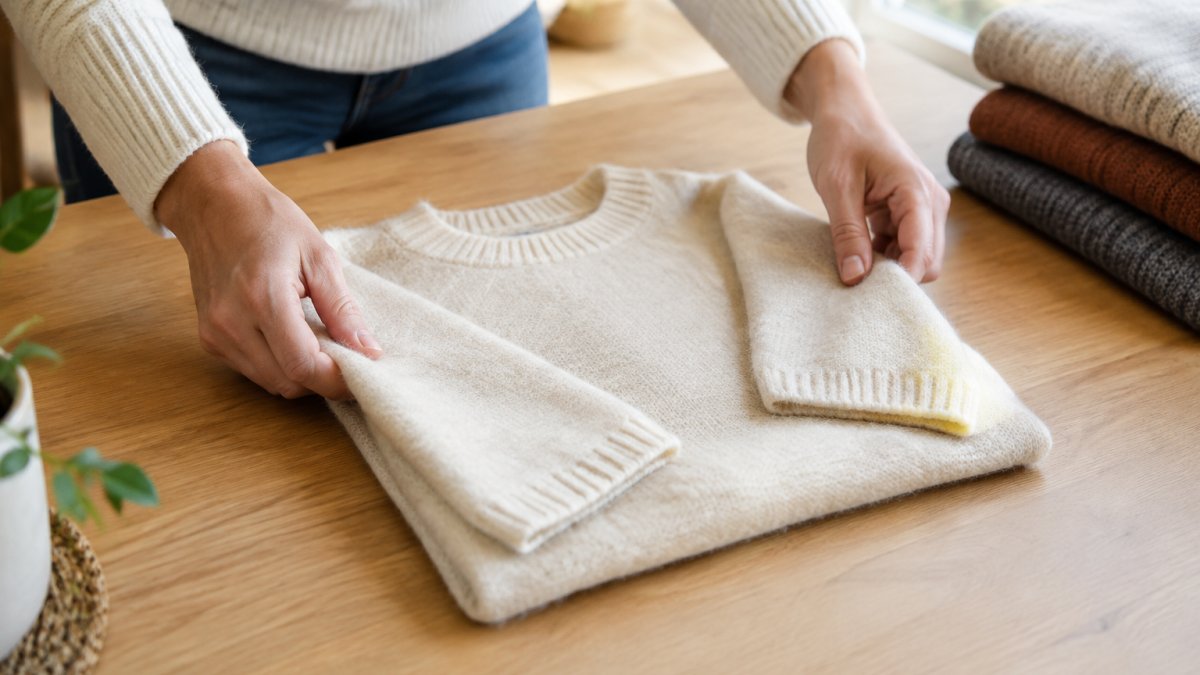
Follow these steps:
- Lay it flat, face down. Smooth the back with your palms, working from the center outward so the knit relaxes before you bend it.
- Fold each sleeve inward. Angle the sleeve diagonally across the back so it lies flat, not bunched at the shoulder. The sleeve should cross the body at a slight downward angle, with the cuff resting near the opposite side seam.
- Fold the sides in. Bring each side toward the center, keeping the fold soft. Stop an inch or two short of the center line so the sweater is not compressed into a tight packet.
- Fold in half or thirds. Match the width of your storage space. Fold along a line that falls between knit panels rather than across a cable, rib, or embellishment.
- Smooth and stack. Never press hard. Let the weight of the stack do the work.
Padding the Fold Points
Alpaca holds the shape it is pressed into, so the single biggest upgrade over a standard sweater fold is padding the fold lines. A common pattern among fiber-care practitioners is to slip a sheet of acid-free tissue paper or a strip of clean, unbleached cotton muslin into each fold before you crease it. The padding rounds the bend instead of sharpening it, so the fiber curves rather than taking a hard line.
- Use one sheet of tissue per major fold for a bulky knit, or a single sheet along the spine of the fold for a lightweight one.
- Extend the tissue slightly past the fold edge so the sweater rests on paper, not on itself.
- Skip colored or printed tissue; unprinted acid-free paper or plain muslin avoids dye transfer to pale alpaca.
Adjusting for Garment Shape and Knit Weight
A tight, dense knit holds a fold line longer than a lofty, brushed knit, so the same fold is not right for every sweater. A few adjustments matter:
- Cable and textured knits: fold between cables, never along one, and pad the fold so the raised pattern is not crushed flat.
- Ribbed cuffs and hems: keep the ribbing out of the fold line; fold just above or below it so the elastic memory is not stretched.
- Embellishments, buttons, and pockets: fold so hardware sits flat against a padded layer, not pressed into the knit beneath it.
How to Fold a Sweater with Sleeves Inward Across the Body
Folding sleeves inward across the body is the step most people rush. Don't. A sleeve bunched at the shoulder creates a bump that presses into the sweater stacked above it.
Lay the sleeve straight, then angle it slightly downward as you fold it across the back. This keeps the shoulder area flat.
Watch out: Folding a sweater while it is still slightly damp from washing or steaming sets a crease into the fiber as it dries.
How to Fold Sweaters in a Drawer for Wrinkle-Free Storage
The best drawer method is the file fold: fold the sweater into a compact rectangle, then stand it upright so you see the front edge, not the top.
Here's why it works. Stacked sweaters press down on each other. Filed sweaters stand side by side, so each one carries only its own weight.
- Fold into a rectangle roughly the width of your drawer's depth.
- Stand each sweater upright, front edge facing out.
- Leave a little breathing room between pieces.
This also saves space. A filed drawer holds as many sweaters as a stacked one and stays neater.
How to Fold Thick Sweaters for Travel Without Wrinkles
For travel, roll thick sweaters instead of folding them flat. Rolling distributes pressure around a curve rather than along a sharp line, so a bulky sweater arrives without hard creases.
Rolling works best for thicker knits and cable styles, where a flat fold would create a deep line. Here's how to fold thick sweaters for travel:
- Lay the sweater face down and fold the sleeves inward.
- Fold the sides toward the center to make a long rectangle.
- Roll from the bottom hem upward, snug but not tight.
- Tuck the roll into a packing cube or the corner of your bag.
Skip vacuum bags for alpaca. Heavy compression flattens the loft. A little air is fine.
Watch out: Rolling a sweater while it's damp traps moisture in the fiber and can set both a crease and a musty smell. Make sure it's fully dry first.
How to Store Alpaca Sweaters Between Seasons
Seasonal storage is where most crease damage happens, because sweaters sit folded for months. Store alpaca sweaters flat, loosely folded, in a breathable cotton bag, and never on a hanger for the off-season.
A few rules keep them crease-free and fresh:
- Fold loosely. A tight fold left for months becomes a permanent line.
- Use a breathable bag, not plastic, so the fiber can breathe.
- Keep the stack shallow so nothing is crushed.
For deeper guidance on long-term storage, see our guide to storing alpaca wool blankets long term. The same principles apply to sweaters.
How to Remove Existing Creases from an Alpaca Sweater Safely
To remove a crease, start by identifying what kind you have. A surface fold line from storage usually lifts with moisture and rest. A set crease, one that has been pressed in for a season or more, needs slower, gentler treatment. Either way, never iron alpaca directly. Heat and pressure from an iron flatten the loft and can scorch the fiber, and the damage is not reversible.
The Steam-and-Rest Method
Steam is the safe tool because gentle moisture relaxes the fiber so the crease lifts on its own. The mechanism is simple: alpaca fiber softens slightly with humidity, and if the garment is supported flat while it dries, the fiber resets in its natural shape rather than in the fold.
- Hang the sweater in a steamy bathroom for 15 to 20 minutes. Run a hot shower and close the door. Hang the sweater away from direct water so it gets humidity, not droplets.
- Lay it flat to finish. Move the sweater to a dry, flat surface, a clean towel over a table works, and smooth the shape gently with your hands while it is still slightly damp.
- Let it rest undisturbed for several hours. This is the step most people skip. The fiber needs time to relax and dry in the flat position; moving it too soon re-forms the crease.
- Check and repeat if needed. A light fold line often lifts in one pass. A set crease may need two or three sessions spaced a day apart.
Handling Set Creases and Stubborn Fold Lines
For a crease that has been in the fiber for months, a handheld garment steamer used at a distance can help, but keep the head several inches from the knit and keep it moving.
- Support the sweater flat while steaming so the weight of the garment does not stretch it as the fiber relaxes.
- Work along the crease line rather than across it.
- Let the sweater cool and dry completely before folding or storing it again.
Watch out: Hanging a damp, steamed sweater to dry puts all its weight on the shoulders and can create the shoulder bumps you were trying to avoid. Always finish drying flat.
What Not to Do
- Do not iron, even on a low setting or through a cloth.
- Do not use a hot dryer or a hair dryer on high heat; heat sets folds rather than releasing them.
- Do not pull or tug at a crease to stretch it out; that distorts the knit and can leave a wavy edge.
If you need to wash it first, our guide on how to wash alpaca sweaters safely walks through the gentle method. And if a sweater has lost its shape, here's how to reshape a stretched out alpaca sweater.
Choosing Your Alpaca Sweater for Crease-Free Care
Some sweaters crease less than others, and construction matters as much as fiber. A tighter, denser knit holds a fold line longer. A loftier, brushed knit springs back.
| Sweater Style | Fiber Blend | Crease Tendency | Best Care |
|---|---|---|---|
| Ebel Alpaca Sweater | 70% alpaca, 30% acrylic | Low, springs back | Fold flat, file in drawer |
| Lattice Cable Mock Sweater | 55% alpaca, 38% Pima cotton, 7% nylon | Moderate, cable texture | Roll for travel, fold at home |
| Capital Crewneck | 68% baby alpaca, 32% organic Pima cotton | Low, smooth drape | Fold flat, hand wash cool |
| Classic Crew Alpaca Sweater | 100% baby alpaca | Low, fine and soft | Fold flat, dry clean |
Our alpaca sweater collection includes the Ebel Alpaca Sweater at $169.95, a versatile 70% alpaca blend with side pockets. For a dressier knit, the Capital Crewneck at $229.95 is a buttery baby alpaca and Pima cotton blend that drapes smoothly and folds without sharp lines.


Best for: everyday wear you'll fold and file in a drawer. Skip if: you want a heavy cable knit for deep winter travel, where the Lattice Cable Mock Sweater at $230.00 rolls better.

Creases come from pressure and bad storage, and both are easy to fix. Fold your alpaca sweaters flat, file them in a drawer, roll them for travel, and store them loose between seasons.
Frequently Asked Questions
How do you fold an alpaca sweater without creasing it?
Lay the sweater flat and smooth out the fabric. Fold each sleeve inward across the back, then fold the sweater in thirds lengthwise rather than in half. Finish with a loose widthwise fold so the knit keeps its loft. Avoid pressing hard along any single line, and avoid hanging an alpaca sweater for long periods.
Should alpaca sweaters be folded or hung?
Fold them. Hanging puts stress on the shoulder area and neckline, and alpaca fiber stretches under its own weight. A folded alpaca sweater keeps its shape and avoids the shoulder bumps hangers create. The exception is very short-term airing, when you can drape the sweater over a padded hanger for an hour or two, then fold it again for storage.
How do you store alpaca sweaters without stretching them?
Fold each sweater loosely and keep the stack shallow so the weight does not compress the knit. Store in a cool, dry place away from direct sunlight.
How do you remove creases from an alpaca sweater?
Lay the sweater flat and let it air dry away from heat, then smooth the area gently with your palm. Do not iron directly, and do not use a hot iron even through a cloth, because heat and pressure can flatten the loft of alpaca fiber permanently.
