



Last Updated: October 27, 2026
Quick Summary
Alpaca wool is generally more durable than cashmere, winning on tensile strength, resilience, and shape retention, while cashmere is softer but pills more readily. However, fiber type alone doesn't decide how long a garment lasts, because knit density, yarn twist, and construction matter more than the label.
- Cashmere pills more readily in everyday use because its short, fine fibers work loose under friction.
- A loosely knit alpaca sweater will fuzz too, so knit density and yarn twist decide more than the label.
- Dry sweaters flat, away from direct heat and sunlight, reshaping them while damp.
- Store sweaters folded, never hung, so shoulders do not stretch.
- Never pull pills off by hand, as it loosens surrounding fibers and accelerates pilling.
Table of Contents
- Alpaca Wool vs Cashmere: The Core Differences
- Alpaca vs Cashmere Pilling: Which Fiber Sheds and Fuzzes Less?
- Alpaca Sweater Durability: What Long-Term Wear Actually Looks Like
- Cashmere Sweater Care: Protecting a Delicate Fiber
- Alpaca vs Cashmere Warmth: Insulation, Breathability, and Weight
- How to Judge Durability Before You Buy
- Choosing an Alpaca Piece That Lasts
- Frequently Asked Questions
Alpaca Wool vs Cashmere: The Core Differences
Alpaca wool vs cashmere durability comparison starts with one uncomfortable fact: fiber type alone doesn't decide how long a garment lasts. Construction does. At Purely Alpaca, we've specialized in alpaca products since 2002. Both fibers are luxury naturals. They age very differently.
Fiber Structure and Diameter
Alpaca fiber is a hollow-cell natural fiber, and that hollow core is why it insulates without bulk. Cashmere fiber comes from the cashmere goat's undercoat and is famously fine, which is exactly what makes it feel soft and wear thin. Fineness cuts both ways: softer against skin, less abrasion resistance.
Strength, Elasticity, and Shape Retention
Alpaca generally wins on tensile strength and resilience. Cashmere has the edge in softness. Staple length matters here: longer fibers spin into stronger yarn, and shorter fibers shed. A tightly twisted yarn with high knit density holds shape through frequent wear far better than a loose, lofty knit in either fiber.
Alpaca vs Cashmere Pilling: Which Fiber Sheds and Fuzzes Less?
Cashmere pills more readily in everyday use. Its short, fine fibers work loose and roll into small balls under friction at cuffs, underarms, and where a bag strap rubs. Alpaca resists pilling better, though it is not immune.
The honest caveat: a loosely knit alpaca sweater will fuzz too. Knit density and yarn twist decide more than the label does. If pilling is your main worry, read our guide to why alpaca wool sweaters pill before you buy, and treat de-pilling as routine maintenance, not a defect.
For the full side-by-side on warmth, softness, and durability, see our alpaca wool vs cashmere warmth comparison.
Alpaca Sweater Durability: What Long-Term Wear Actually Looks Like
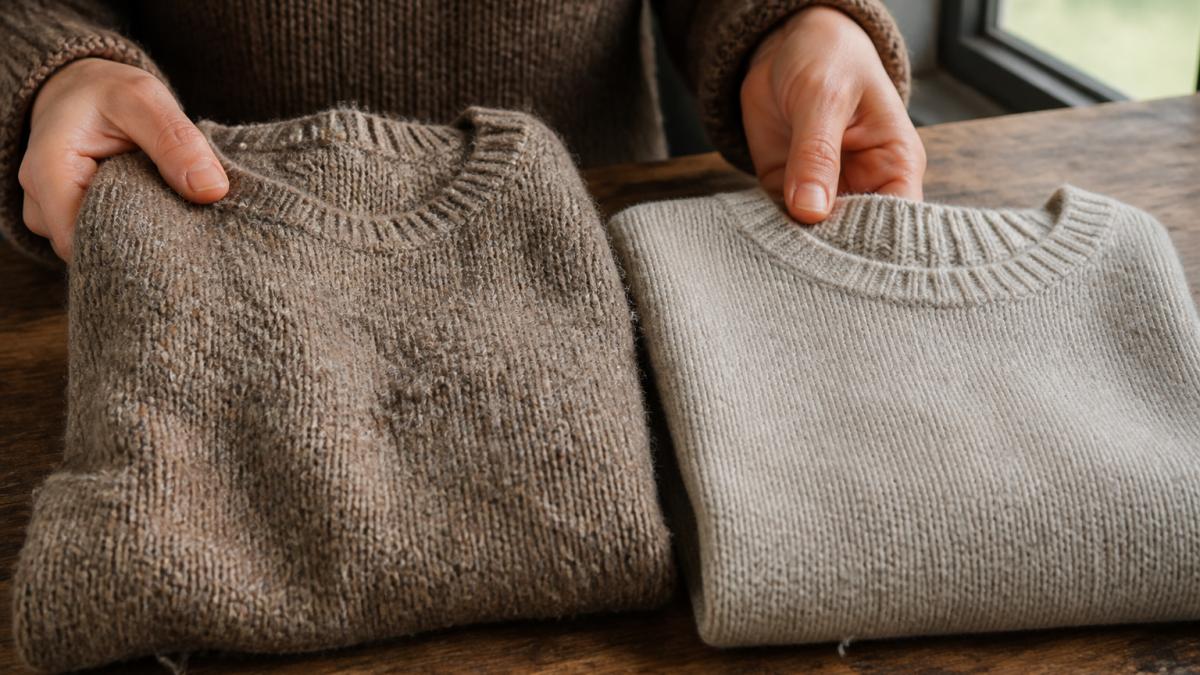
"Durability" is not one property. A garment can resist rubbing yet pill badly, or hold its shape yet fail at a seam. To compare alpaca and cashmere honestly, separate the outcomes:
- Abrasion resistance, how the surface survives rubbing at cuffs, underarms, and bag-strap contact.
- Pilling, whether loose fibers roll into balls under friction.
- Tensile strength, how much pulling the yarn takes before it breaks.
- Seam and join failure, whether stitching or underarm joins give out before the fabric does.
- Shape retention, whether the knit springs back after stretching or relaxes permanently.
What Long-Term Wear Actually Looks Like
Wear shows up in predictable places. Elbows thin first on sleeves that rub desks and armrests. Cuffs relax where hands push through them daily. Side seams pull where the garment is stressed across the hips or shoulders. Underarm joins fail where friction and moisture combine.
A common mistake is judging durability by feel alone. For practical steps to prevent pilling on alpaca sweaters, proper washing, drying, and storage make the biggest difference.
Fiber Grade and Garment Construction
- Tight, even stitch definition with no gaps
- A firm yarn twist that resists abrasion
- Reinforced seams and ribbed cuffs
- Longer staple length in the fiber
For the full side-by-side on warmth, softness, and durability, see our alpaca wool vs cashmere warmth comparison.
Cashmere Sweater Care: Protecting a Delicate Fiber
Care is where durability is won or lost, and it is the part of the comparison most guides skip. The same washing, drying, and storage habits affect alpaca and cashmere differently, so treat care as a durability decision rather than housekeeping.
100% Baby Alpaca Scarf - Woven Solid →
Washing
If you use a machine's hand-wash or wool cycle, use a mesh bag and the lowest spin setting. Even then, most practitioners treat machine washing as a risk rather than a routine.
Drying
Dry flat, away from direct heat and sunlight, reshaping the garment to its original dimensions while damp. Hanging a wet sweater stretches shoulders and lengthens the body, damage that shape retention cannot undo.
Storage
Store folded, never hung, so shoulders do not stretch. Clean before storing, because moths are drawn to soil and sweat residue. Cedar blocks or sealed storage help; check stored pieces periodically for signs of pests.
De-Pilling
Alpaca needs similar gentleness but tolerates handling better. Our complete guide to washing alpaca wool sweaters covers the details.
Alpaca vs Cashmere Warmth: Insulation, Breathability, and Weight
For travel and layering, alpaca's warmth-to-weight ratio is the practical advantage. For pure next-to-skin softness, cashmere still has loyal fans. Neither is "better" in the abstract; the use case decides.
How to Judge Durability Before You Buy
- Hold it to light: can you see gaps between stitches?
- Stretch a cuff gently: does it spring back or stay stretched?
- Rub the surface: does fiber lift immediately?
- Check the label for fiber grade and blend percentage
- Inspect seams and underarm joins for reinforcement
- Ask about care requirements before committing
| Durability Measure | What It Means | Alpaca | Cashmere |
|---|---|---|---|
| Tensile strength | Resistance to pulling and tearing | Stronger | Lower |
| Abrasion resistance | Resistance to rubbing wear | Good | Moderate |
| Resilience | Spring-back after stretching | High | Moderate |
| Pilling tendency | Fiber balling at friction points | Lower | Higher |
| Shape retention | Holding fit over time | Better | Relaxes |
| Softness | Hand feel against skin | Soft | Softer |
Choosing an Alpaca Piece That Lasts
Shop our alpaca sweaters and cardigans collection.
Best for: Skip if:
Frequently Asked Questions
Is alpaca wool more durable than cashmere?
Alpaca wool generally holds up better than cashmere in everyday wear. Alpaca fiber has a longer staple length and higher tensile strength, and it lacks the microscopic scales found on cashmere, so it resists abrasion and matting more effectively. That said, knit density and yarn twist matter as much as fiber type. A tightly knitted baby alpaca piece will outlast a loosely woven cashmere one, so check construction before assuming fiber alone decides durability.
Which pills more, alpaca or cashmere?
Cashmere tends to pill more than alpaca. Its short fibers work loose from the yarn during friction and form small balls on the surface. Alpaca's longer fibers stay anchored in the yarn longer, which reduces pilling and shedding. Loosely spun yarns and low knit density increase pilling in either fiber, so a well-constructed alpaca garment with a tight knit will show noticeably less fuzz over a season of frequent wear.
Is alpaca warmer than cashmere?
Alpaca is generally warmer for its weight. The fiber has a hollow core that traps air, and it provides insulation even when damp, which matters for hiking and winter sports. Cashmere is exceptionally soft and warm but loses insulating performance faster when wet. For cold, wet conditions, alpaca vs cashmere warmth favors alpaca. For indoor luxury and next-to-skin softness, many buyers still prefer cashmere's feel.
How should you care for alpaca and cashmere clothing?
Purely Alpaca scarves list dry clean or hand wash as the recommended care.
The real challenge isn't picking between two luxury fibers. It's finding construction that honors the fiber. Purely Alpaca has offered 100% baby alpaca pieces since 2002, with free shipping on orders of $100 or more and hassle-free returns. Get started with Purely Alpaca and choose a garment built to outlast the trend.
