




Table of Contents
- Act Fast: Immediate Stain Response
- Best Detergent for Alpaca Sweaters and Knitwear
- How to Wash Alpaca Wool by Hand
- How to Dry Alpaca Knitwear Without Stretching
- Stain-Specific Removal Protocols
- Common Mistakes to Avoid When Removing Stains From Alpaca Knitwear
- When to Seek Professional Cleaning
- Frequently Asked Questions
Last Updated: September 30, 2026
Alpaca knitwear is an investment in comfort and luxury. When a stain appears on your favorite sweater or scarf, panic is natural. But you can remove stains alpaca knitwear safely without a trip to the dry cleaner. The key is acting fast and using the right approach.
This guide covers everything you need to know about protecting your alpaca pieces from stains and removing them safely. Purely Alpaca has specialized in alpaca products since 2002.
Act Fast: Immediate Stain Response
The first 15 minutes are critical, your response determines whether a stain sets permanently or comes out completely.
Blot, don't rub. Grab a clean, lint-free cloth and gently press it against the stain. Rubbing pushes the stain deeper into the fiber. Blotting lifts it away.
For wet stains, work from the outside edges toward the center to prevent spreading. For dry stains, let the garment sit, then gently brush with your hand to loosen dried material.
Cold water only. Warm or hot water sets protein-based stains like milk, egg, or blood. Cold water is your first line of defense.
Best Detergent for Alpaca Sweaters and Knitwear
Not all detergents work on alpaca fiber. Harsh chemicals and alkaline cleaners damage the delicate protein structure.

Mild, pH-neutral cleaners are essential. According to Knitbrary's fiber care guidelines, mild detergents and baby shampoo are the safest choices for alpaca and similar natural fibers. The pH-neutral formula protects fiber integrity while removing dirt and stains.
Good options include:
- Baby shampoo (mild and designed for sensitive skin)
- Wool-specific detergents
- Gentle pH-neutral soaps
- Specialized alpaca fiber cleaners
Avoid these entirely:
- Bleach (destroys the fiber)
- Fabric softener (coats the fiber and dulls luster)
- Regular laundry detergent (too harsh)
- Enzyme-based cleaners (break down protein fibers)
Alpaca fiber is a protein, similar to human hair. Alkaline cleaners open the fiber cuticle and cause damage; pH-neutral formulas keep it smooth and intact.
When you're ready to clean, use only a small amount. A teaspoon of mild detergent mixed with cold water is enough for most stains.
How to Wash Alpaca Wool by Hand
Hand washing is the only safe way to clean alpaca knitwear. Machine washing creates friction that felts the fiber and causes shrinkage.
Here's the step-by-step process:
- Fill a basin with cool water (65-75°F).
- Add a teaspoon of mild detergent and stir gently.
- Submerge the garment and soak for 10-15 minutes without agitating.
- Gently work the soapy water through the fiber, paying extra attention to stains.
- Rinse thoroughly with fresh cool water 2-3 times until no soap remains.
- Remove excess water by pressing gently. Never wring or twist.
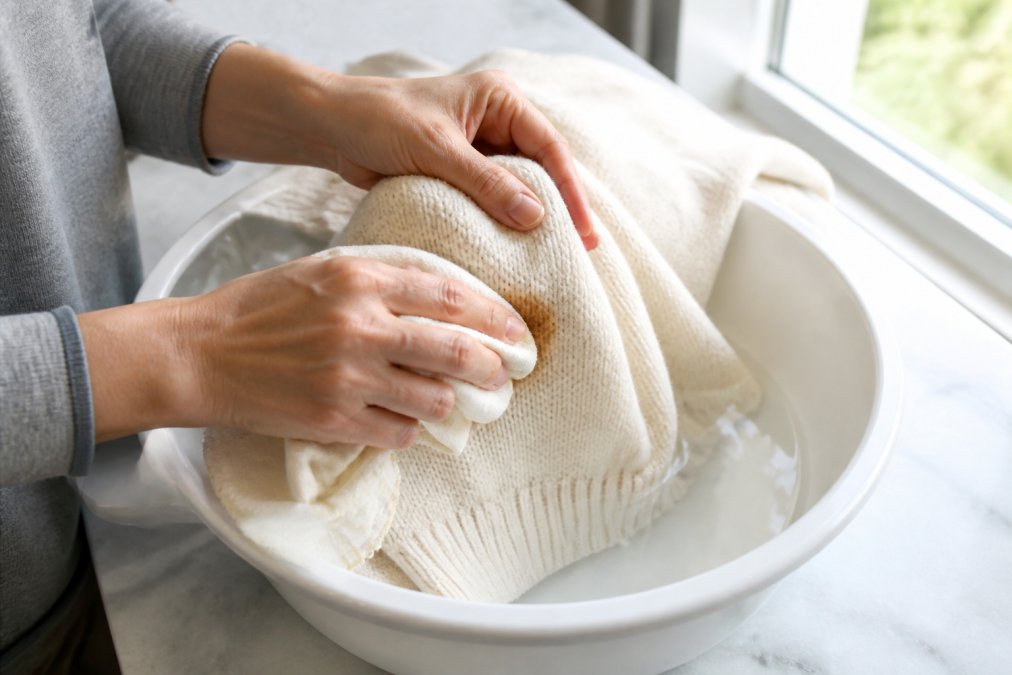
Spot Cleaning vs. Full Immersion
Spot clean small, fresh, localized stains (takes 5-10 minutes). Use full immersion for multiple stains, stains set longer than 6 hours, or overall dirt buildup.
For spot cleaning, mix a teaspoon of mild detergent with cold water. Dampen a lint-free cloth and gently dab the stain, working from outside edges toward the center. Rinse with plain cold water and repeat until the stain is gone.
How to Dry Alpaca Knitwear Without Stretching
Flat drying is the only safe method. Lay the garment flat on a clean, dry surface. Reshape it gently while damp and check every few hours. This takes 24-48 hours depending on humidity.
To speed drying: use a fan for air circulation, open windows on dry days, and avoid direct sunlight.
Stain-Specific Removal Protocols
Different stains require different approaches. Match your response to the stain type and how long it has been setting.
Protein-Based Stains (Blood, Milk, Egg)
Immediate action: Blot with cold water only, warm water sets these stains by bonding protein to fiber. If stain persists: Mix a teaspoon of mild detergent with cold water, dab gently, let sit 2-3 minutes, then rinse. Repeat up to three times.
Oil or Grease Stains
Immediate action: Let the stain dry completely (2-4 hours), water spreads oil deeper. Once dry: Gently brush to loosen residue. For remaining oil, dampen a cloth with cold water and mild detergent, dab gently 4-6 times, rinsing between passes.
Wine, Juice, or Colored Liquid Stains
Immediate action: Blot with cold water only, this removes 70-80% of fresh color. Before treating: Perform a colorfastness test on a hidden area. If dye bleeds, seek professional help. If test passes: Mix mild detergent with cold water, dab gently, let sit 2-3 minutes, rinse, and repeat up to three times.
Mud or Dirt Stains
Immediate action: Let mud dry completely (4-8 hours). Once dry: Gently brush by hand or with a soft-bristled brush. If residue remains: Blot with cold water only, detergent is not needed for mud.
Decision Matrix: Spot Clean vs. Full Immersion
Use this framework to decide your approach:
- Spot clean if: The stain is small (less than 2 inches), localized to one area, and fresh (less than 6 hours old). Spot cleaning takes 5-10 minutes and minimizes fiber stress.
- Full immersion if: Multiple stains exist across the garment, the stain has set for more than 6 hours, or the garment has visible dirt or odor buildup. Full immersion takes 20-30 minutes but addresses the entire piece.
- Seek professional help if: The stain covers more than 3 inches, has been present for more than one week, does not respond to home treatment after three attempts, or you are uncertain about colorfastness.
The common thread across all stain types: cold water first, gentle blotting always, mild detergent only when necessary, and patience throughout.
Common Mistakes to Avoid When Removing Stains From Alpaca Knitwear
Even well-intentioned care can damage alpaca fiber. Here are the mistakes that cause the most harm when you remove stains alpaca knitwear, and the mechanisms behind why they matter.
Physical Damage Mistakes
Wringing or twisting. This breaks the fiber structure and causes permanent stretching. Alpaca fibers cannot return to their original shape once stretched. Always press gently instead.
Chemical and Temperature Mistakes
Using hot water. Heat serves two damaging functions: it sets protein-based stains by causing them to bond to the fiber, and it causes alpaca fiber to felt. Felting occurs when heat causes the microscopic scales on the fiber surface to open and lock together, permanently matting the fiber. Even lukewarm water above 75°F can initiate this process. Stick with cool water (65°F or below).
The Colorfastness Mistake (Most Commonly Overlooked)
Ignoring colorfastness before treatment. This is the mistake that causes the most irreversible damage and is almost never mentioned in standard care guides. Before using any cleaning solution on a visible area, you must test it on a hidden spot. Some dyes used in alpaca knitwear, particularly natural dyes and certain semi-synthetic dyes, can bleed or change color when exposed to detergent, even mild detergent.
How to perform a colorfastness test:
- Choose an inconspicuous area: an inside seam, underarm, hem, or back neckline where color loss would not be visible.
- Mix your cleaning solution: one teaspoon of mild detergent with one cup of cold water.
- Dampen a white or light-colored cloth with this solution.
- Apply the damp cloth to the hidden area and press gently for 30 seconds.
- Wait 5 minutes without disturbing the area.
- Blot with a dry white cloth and inspect both the garment and the cloth.
- If dye transfers to the cloth, or if the color of the garment changes, do not proceed with this solution. Seek professional cleaning instead.
The Escalation Mistake
Continuing to treat a stain that isn't responding. After three gentle attempts with cold water and mild detergent, if the stain remains visible, stop. Continuing to treat it risks damaging the fiber through repeated friction and chemical exposure. At this point, professional cleaning is the better choice. A cleaner experienced with alpaca has access to specialized solvents and equipment that can address stubborn stains without the risk of home treatment.
When to Seek Professional Cleaning
Some stains are worth leaving to professionals. Knowing when to stop trying and call in experts saves your garment.
Seek professional help for:
- Stains that don't respond to spot cleaning after three attempts
- Stains that have set for more than a week
- Large stains covering significant portions of the garment
- Stains from unknown sources
- Delicate or heavily embellished pieces
- Vintage or irreplaceable items
Prevention through proper care is always the better investment.
Frequently Asked Questions
Can I use bleach to remove stains from alpaca knitwear?
No. Bleach and chlorine-based cleaners will damage alpaca fiber permanently, causing discoloration, weakening, and loss of softness. Stick to mild, pH-neutral detergents or baby shampoo for all stain removal on alpaca knitwear. For stubborn stains, test any solution on an inconspicuous area first.
What's the best detergent for alpaca sweaters?
Use mild, pH-neutral detergents, baby shampoo, or wool-specific cleaners designed for delicate natural fibers. Avoid regular laundry detergent, which contains harsh chemicals that damage alpaca fiber. Look for products labeled as safe for wool or delicate fabrics. Always use cold water to prevent fiber damage and color fading.
Is it okay to put alpaca wool in the dryer?
Machine drying is not recommended for alpaca knitwear. High heat causes shrinkage, stretching, and fiber damage. Always air dry flat on a clean, lint-free surface away from direct sunlight or heat sources. Flat drying preserves the garment's shape and protects the delicate alpaca fiber from damage.
How long does it take to remove a stain from alpaca knitwear?
Fresh stains typically respond to spot cleaning within minutes to an hour of treatment. Older or set-in stains may require multiple gentle applications over several hours or days. Always work slowly and avoid rubbing aggressively, which can push the stain deeper into the alpaca fiber or cause matting and damage.
Protecting alpaca knitwear from stains starts with knowing how to respond in the first few minutes. Blot, use cold water, and reach for mild detergent. These three habits prevent most stains from setting permanently. When accidents happen, remember that alpaca fiber is delicate but resilient. Gentle handling and patience restore your pieces to like-new condition. For sweaters, scarves, and socks from Purely Alpaca, proper stain care means years of warmth and comfort ahead.