





Table of Contents
- Is Alpaca Wool Eco-Friendly? The Short Answer
- Environmental Impact of Alpaca Fiber Production
- Alpaca Wool vs. Sheep Wool Environmental Impact
- Biodegradability and Natural Properties
- Ethical Alpaca Farming Practices and Animal Welfare
- Chemical-Free Processing and Sustainable Manufacturing
- Alpaca Wool in the Circular Economy
- Pros and Cons: Is Alpaca Wool Truly Eco-Friendly?
Last Updated: August 3, 2026
Is Alpaca Wool Eco-Friendly? The Short Answer
Whether alpaca wool is eco-friendly deserves a nuanced answer. At Purely Alpaca, we've spent over two decades sourcing alpaca products, and the environmental reality is more complex than marketing claims suggest. Alpaca wool offers genuine advantages over synthetic fibers, it's biodegradable, requires minimal chemical processing, and comes from animals with a smaller land footprint than sheep. But alpaca production isn't perfect: animals produce methane emissions, grazing can degrade fragile mountain ecosystems if not managed carefully, and not all operations prioritize sustainability equally.
The honest answer: alpaca wool is more eco-friendly than most synthetic fibers and conventional sheep wool, but less eco-friendly than some alternatives like organic linen or hemp.
Environmental Impact of Alpaca Fiber Production
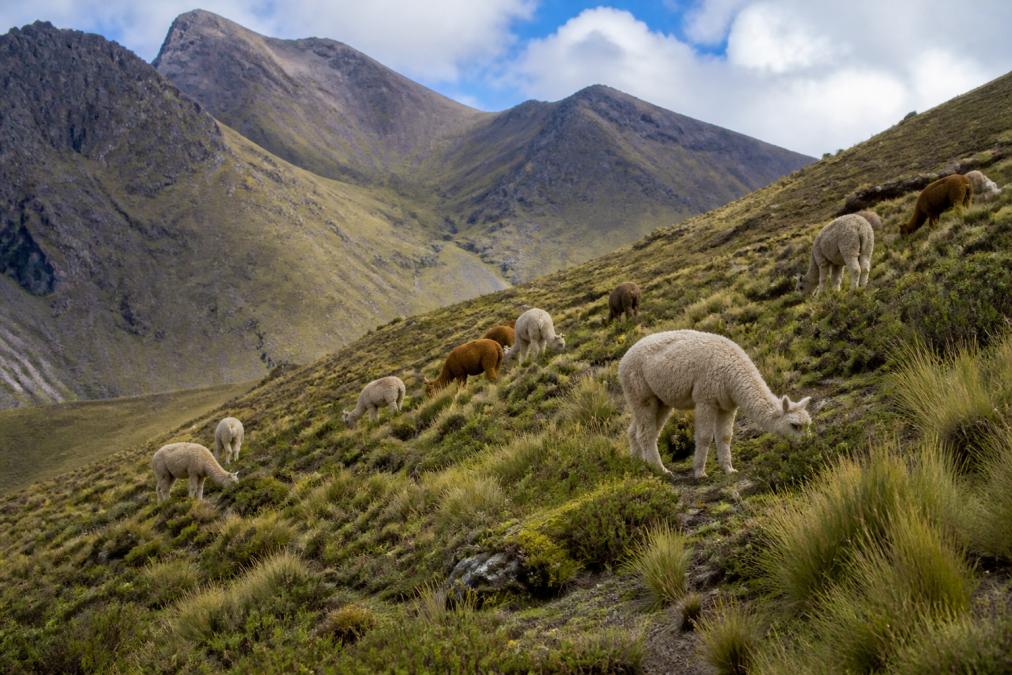
Alpacas are native to the Andes Mountains and thrive in high-altitude ecosystems where few other livestock can survive. This means alpaca farming doesn't require converting biodiverse grasslands into pasture. However, overgrazing in fragile mountain ecosystems can lead to soil erosion and vegetation loss. Well-managed farms rotate grazing areas and maintain lower animal densities, preserving soil structure. The environmental impact depends heavily on farm-specific practices.
Alpacas produce roughly 8 kilograms of methane per year, less than sheep (14-15 kg annually) but still a meaningful greenhouse gas contribution. Transportation of raw fiber from South America to manufacturing facilities also contributes to the overall carbon footprint.
Carbon Footprint and Greenhouse Gas Emissions
A kilogram of clean alpaca fiber typically has a carbon footprint of 8-12 kg CO2 equivalent when accounting for all production stages, lower than conventional sheep wool (10-25 kg CO2e per kilogram) but higher than some plant-based fibers like linen.
The advantage over synthetic fibers is pronounced. Polyester production requires petroleum extraction and energy-intensive manufacturing, with a carbon footprint around 5-8 kg CO2e in production alone. However, polyester doesn't biodegrade and most ends up in landfills for decades. Over a fiber's full lifecycle, synthetic fibers typically accumulate 15-30 kg CO2e per kilogram.
Alpaca wool's carbon advantage compounds if worn longer and eventually biodegrades. A sweater worn for ten years has a lower annual carbon cost than one worn for two years.
Water Consumption and Land Use
Alpacas are significantly more water-efficient than sheep or cattle, drinking roughly 2-3 gallons per day. The real water impact comes from fiber processing: raw fleece requires 50-100 gallons of water per kilogram for washing, depending on the facility. Facilities using recycled water systems significantly reduce net water impact.
Alpacas require less land per animal than sheep, roughly 1 acre per 6-10 alpacas versus 1 acre per 4-6 sheep. More importantly, they graze in terrain unsuitable for most other livestock, avoiding ecosystem conversion. This gives alpaca farming a lower land-use impact in terms of habitat destruction, though grazing intensity on marginal lands still affects soil health.
Alpaca Wool vs. Sheep Wool Environmental Impact
Merino sheep produce higher fiber yields per animal (4-6 kg annually versus alpacas' 1.5-2.5 kg), requiring fewer animals for equivalent volume. However, sheep require more intensive management, more land per animal, and produce higher methane emissions individually. The trade-off isn't clear-cut.
Sheep wool often undergoes chemical scouring using hot water and detergents to remove lanolin. Alpaca fiber contains minimal lanolin, requiring less aggressive chemical processing. This reduces water pollution and chemical inputs during cleaning.
Both fibers are biodegradable and break down in soil over 1-5 years. However, sheep wool often undergoes chemical treatments (mothproofing, stain resistance) that slow biodegradation and introduce synthetic chemicals into soil.
| Attribute | Alpaca Wool | Sheep Wool (Merino) | Synthetic Fiber (Polyester) |
|---|---|---|---|
| Annual yield per animal | 1.5-2.5 kg | 4-6 kg | N/A (industrial) |
| Methane per animal annually | ~8 kg CO2e | ~14-15 kg CO2e | 0 |
| Land efficiency | High (marginal terrain) | Moderate | N/A |
| Processing chemicals | Minimal | Moderate to high | High |
| Biodegradability | 1-5 years | 1-5 years | 200+ years |
| Water use in processing | 50-100 gal/kg | 60-120 gal/kg | 700+ gal/kg |
Alpaca wool has a slight environmental advantage over conventionally produced sheep wool, particularly in processing chemicals and water use. Well-managed merino operations can rival alpaca's sustainability. The key differentiator is farming practice and processing method.
Biodegradability and Natural Properties
Alpaca wool breaks down naturally within 1-5 years when exposed to soil microbes and moisture. This biodegradability is fundamental to the fiber's protein-based structure. If an alpaca garment is discarded, it returns to soil rather than accumulating as persistent waste.
Alpaca fiber has natural hypoallergenic properties due to minimal lanolin content, requiring less aggressive chemical treatment. Alpaca wool's superior insulation means thinner, lighter garments can provide equivalent warmth as thicker synthetic alternatives, reducing material use and transportation energy.
End-of-Life Cycle Analysis
Alpaca wool garments can be composted in commercial facilities or left in soil, where they decompose completely within 2-5 years with no toxic residue. Polyester and acrylic garments persist indefinitely, most ending up in landfills for centuries or being incinerated, releasing carbon and emissions.
Damaged alpaca garments can be shredded and used as mulch, animal bedding, or soil amendment. The fiber simply returns to biological cycles without energy-intensive recycling.
Microplastic Shedding vs. Synthetic Fibers
Alpaca wool does not generate microplastics. Because it's a natural protein fiber, it breaks down into organic compounds consumed by soil microbes, not persistent plastic particles. Washing a synthetic fleece jacket releases an estimated 250,000 microplastic particles per wash. An alpaca wool sweater releases zero microplastics. Over a garment's lifetime, the microplastic difference is measured in hundreds of millions of particles.
Ethical Alpaca Farming Practices and Animal Welfare
Environmental sustainability is inseparable from animal welfare. Farms treating alpacas poorly often degrade land and use unsustainable practices. Conversely, farms committed to animal welfare typically implement rotational grazing and soil monitoring.
Alpacas are social, intelligent animals that thrive in herds and don't require intensive handling or chemical treatments. Ethical concerns arise in operations prioritizing profit over comfort: overcrowding, inadequate shelter, poor nutrition, and rough handling are red flags.
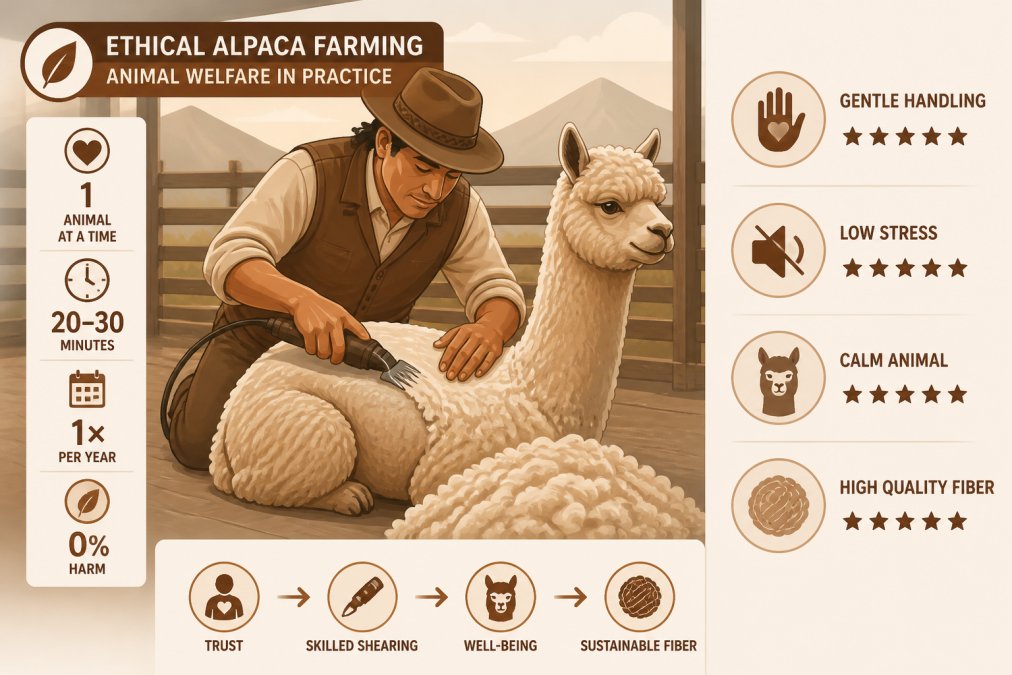
Traceability is essential. Knowing where your fiber comes from allows informed choices about whether the product aligns with your values. Farms prioritizing animal welfare invest in land management and long-term stewardship, practices that also reduce environmental degradation.
Chemical-Free Processing and Sustainable Manufacturing
Alpaca wool requires minimal chemical processing because it contains very little lanolin compared to sheep wool. This translates to lower water pollution and fewer toxic inputs during manufacturing.
Sustainable processing involves shearing, washing with biodegradable soaps, drying, carding, and spinning. Some facilities recycle water through filtration systems, dramatically reducing consumption. The dyeing stage is where chemical inputs become problematic. Sustainable manufacturers use low-impact dyes from plant materials or fiber-reactive dyes with closed-loop water systems.
Alpaca garments don't require special care like dry cleaning or chemical stain treatments, reducing the consumer's environmental footprint over the garment's lifetime.
Alpaca Wool in the Circular Economy
Alpaca wool fits circular economy models naturally due to its biodegradability. Alpaca garments worn out or damaged can be composted in commercial facilities or home systems, where they break down and return nutrients to soil. This is a true circular process with no waste stage.
This contrasts sharply with synthetic fibers, which cannot be composted. Polyester recycling requires significant energy and often results in lower-quality fiber that eventually ends up in landfills or incinerators anyway.
Pros and Cons: Is Alpaca Wool Truly Eco-Friendly?
Environmental Pros:
- Fully biodegradable with zero microplastic shedding
- Lower methane emissions per animal than sheep or cattle
- Minimal chemical processing, reducing water pollution
- Suitable for marginal terrain, avoiding ecosystem conversion
- Superior insulation allows thinner garments using less material
- Potential for composting and circular economy models
Environmental Cons:
- Methane emissions from animal digestion
- Grazing can degrade fragile ecosystems if not managed carefully
- Long-distance transportation from South America increases carbon footprint
- Processing water use can be substantial without recycling systems
- Not all alpaca farms prioritize sustainability equally
- Supply chain transparency is often limited
Comparison Summary: Alpaca wool ranks higher than synthetic fibers in nearly every environmental category. It's comparable to well-managed sheep wool and superior to conventionally produced merino. It falls behind some plant-based alternatives like organic linen in carbon footprint but exceeds them in thermal performance and durability.
| Metric | Alpaca Wool | Sheep Wool | Polyester | Linen |
|---|---|---|---|---|
| Biodegradable | Yes (1-5 years) | Yes (1-5 years) | No (200+ years) | Yes (1-2 years) |
| Microplastic shedding | None | None | Significant | None |
| Processing chemicals | Minimal | Moderate | High | Moderate |
| Land conversion required | No | Sometimes | No | Sometimes |
| Carbon footprint (kg CO2e/kg) | 8-12 | 10-25 | 5-8 | 4-6 |
| Thermal efficiency | Excellent | Good | Good | Fair |
Alpaca wool is more sustainable than most mainstream fiber choices, particularly synthetic alternatives. It biodegrades completely, generates no microplastics, and requires minimal chemical processing. However, sustainability depends on specific farming practices and manufacturing methods, not all alpaca is created equal.
If environmental impact matters in your purchasing decisions, alpaca wool from transparent, ethically managed farms represents a genuinely better choice than polyester or acrylic. When you buy from Purely Alpaca, you're choosing fiber sourced from farms committed to animal welfare and sustainable land management, processed without harsh chemicals, and designed to last decades. That durability, a sweater worn for ten years rather than two, is perhaps the most important factor in reducing your personal environmental footprint. Get started with Purely Alpaca and make a choice that aligns your wardrobe with your values.
Frequently Asked Questions
Is alpaca wool eco-friendly compared to synthetic fibers like polyester?
Alpaca wool is biodegradable and breaks down naturally in soil, whereas synthetic fibers shed microplastics that persist in the environment for decades. Alpaca fiber requires no chemical-heavy processing to achieve its natural insulation and moisture-wicking properties. However, alpaca production does generate some greenhouse gas emissions through livestock farming. The key difference: alpaca fiber returns to the earth; synthetics do not.
What makes ethical alpaca farming practices important for sustainability?
Ethical alpaca farming practices ensure animals are treated humanely, which supports regenerative grazing that can improve soil health and carbon sequestration. Farms practicing rotational grazing reduce land degradation and allow pastures to recover. Traceability from farm to finished product builds consumer confidence that environmental standards are actually met. Look for suppliers who document their sourcing and animal welfare standards transparently.
How does alpaca wool's water consumption compare to other natural fibers?
Alpacas require less water than sheep and consume minimal supplemental feed in most climates, reducing overall water usage in fiber production. The fiber processing itself uses water, but high-quality producers employ low-impact dyes and biodegradable soaps rather than harsh chemicals. While exact water figures vary by farm and region, alpaca's lower input requirements generally result in reduced water consumption versus conventional wool production.
I have sensitive skin and get itchy with regular wool. Will alpaca fiber irritate my skin?
Alpaca fiber is naturally hypoallergenic because it lacks lanolin, the waxy substance in sheep's wool that often triggers irritation and itching. The fiber is smoother and finer than most sheep wool, making it gentler against sensitive skin. Many people with eczema and wool allergies find alpaca comfortable. However, individual reactions vary, so check the return policy before purchasing if you're unsure.
This article was written using GrandRanker