



Table of Contents
- Why Alpaca Knitwear Deserves Proper Repair
- Identifying the Type of Hole in Your Alpaca Garment
- Tools and Materials You'll Need for Darning Alpaca Wool
- Step-by-Step Darning Technique for Small Holes
- Using a Speed-Weave or Darning Loom
- Repairing Holes in Cuffs and Ribbing
- How to Prevent Moth Holes in Sweaters
- When to Seek Professional Repair Services
- Frequently Asked Questions
Last Updated: September 25, 2026
Why Alpaca Knitwear Deserves Proper Repair
Alpaca fiber is special. It's softer than merino wool, warmer than cashmere, and naturally hypoallergenic, which is why people invest in quality alpaca pieces. But here's what most people miss: learning how to repair small holes in alpaca knitwear means your sweater doesn't have to be done.
Small holes in alpaca knitwear can be fixed at home with the right technique.
The challenge is understanding how alpaca fiber behaves. Unlike synthetic materials, alpaca has a delicate structure, and aggressive repair methods can damage the fiber halo. This guide walks you through how to repair small holes in alpaca knitwear without compromising quality.
Identifying the Type of Hole in Your Alpaca Garment
Not all holes are created equal. The repair method depends on what caused the damage and where it's located.
Moth damage creates small, irregular holes with ragged edges, often in clusters across the garment.
Snags and pulls create a ladder-like run with loose stitches extending from a small hole. This damage spreads quickly if not secured.
Wear holes develop from friction in high-stress areas like elbows, cuffs, or bag straps, appearing as round holes.
Pilling isn't technically a hole, but it's worth mentioning. Small balls of fiber form on the surface. This is fixable with a fabric comb and doesn't require darning.
Location matters: holes in the garment body need different treatment than holes in ribbing or cuffs, which have a tighter knit structure.
Tools and Materials You'll Need for Darning Alpaca Wool
Essential tools:
- Tapestry needle (size 18-20 for fine alpaca)
- Embroidery thread or yarn in matching color
- Small scissors
- Darning loom or speed-weave tool (optional but helpful)
- Magnifying glass (optional, useful for detail work)
Optional but recommended:
- 21-hook Speedweve tool for structural repairs
- Blocking mat for finishing
- Stitch markers to hold stitches in place
Needle size is critical for fine-gauge alpaca knitwear. A needle that's too large creates new holes; too small is frustrating to thread.
Matching yarn weight is critical: too thick creates bumps, too thin won't hold. Most alpaca uses DK or sport weight. Test your match on an inconspicuous area first.
Best Needles for Mending Knitwear
The right needle makes the difference between a repair that lasts and one that unravels.
Tapestry needles (sizes 18-22) are standard for alpaca knitwear. Their blunt tip slides between stitches without splitting yarn. Use sizes 18-20 for most pieces, 20-22 for fine garments.
Embroidery needles can split delicate alpaca fibers; use them only for reinforcement, not main darning.
Avoid sewing needles. They're too small and sharp for knitwear repair.
The needle's eye should accommodate your thread comfortably without forcing it. If the thread frays as you thread the needle, your needle is too small.
Matching Yarn Weight and Color
This is where visible mending becomes either invisible or intentionally decorative.
For invisible repairs, match yarn weight and color closely. Take a garment sample to a yarn shop and compare under natural light, as dye lots vary.
For visible mending, use contrasting yarn intentionally. This slow fashion approach turns a repair into a design feature.
If you can't find an exact match, choose slightly darker yarn; light thread on dark fabric is more noticeable.
Test your yarn on a hidden area first by unraveling a small section of the hem or seam and practicing a few stitches.
Step-by-Step Darning Technique for Small Holes
Darning is the most common repair method for small holes in alpaca knitwear. It works by weaving new yarn through the existing knit structure to close the gap.
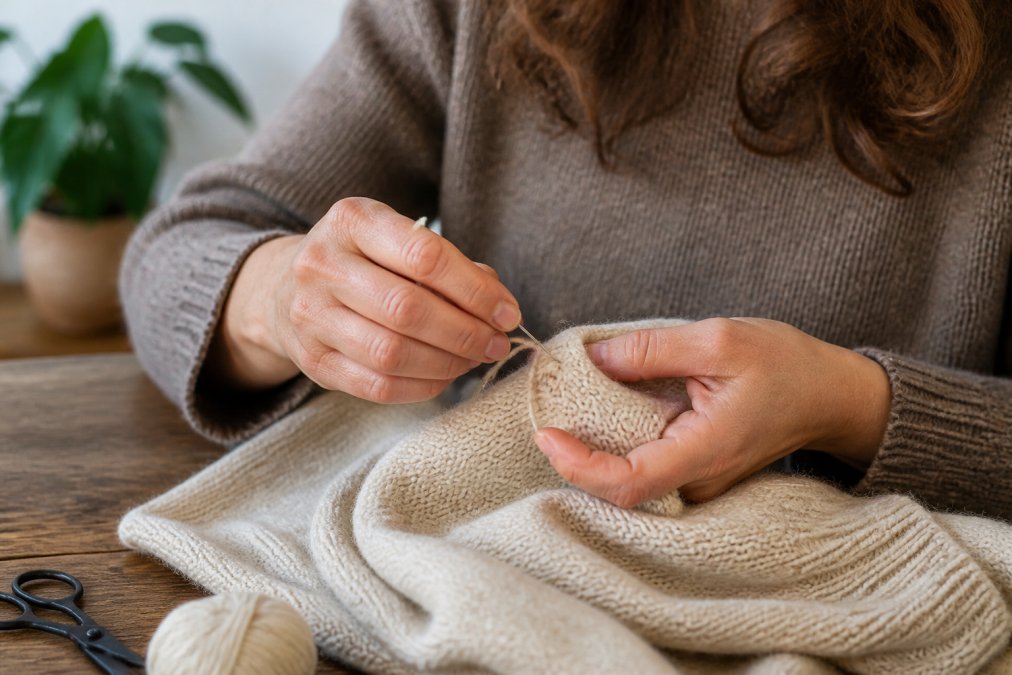
Step 1: Prepare the garment (Time: 5 minutes) Lay the sweater flat under good lighting. Gently pull loose threads toward the center to minimize the damaged area.
Step 2: Secure the garment (Time: 2 minutes) Use stitch markers or safety pins to hold the fabric taut but not stretched.
Step 3: Thread your needle (Time: 2 minutes) Cut 18 inches of yarn, thread through your needle, and knot the end loosely to hide on the back.
Step 4: Start at the edge (Time: 10 minutes) Begin darning about half an inch from the hole's edge as your anchor point. Create a grid pattern covering the entire damaged area.
Step 5: Weave horizontally (Time: 15 minutes) Weave horizontally across the hole, over and under existing stitches. Keep tension consistent, not too tight (puckers fabric) or too loose (won't hold). Stitches should sit flat.
Step 6: Weave vertically (Time: 15 minutes) Weave perpendicular to horizontal stitches, creating an interlocking grid that holds the repair in place.
Step 7: Blend the edges (Time: 10 minutes) Extend weaving slightly beyond the hole's edge. Use a duplicate stitch for outermost rows to match the original knit pattern.
Step 8: Secure and finish (Time: 5 minutes) Weave your needle through the back of stitches to secure the thread. Trim excess yarn. The repair should look flat and blend seamlessly.
Securing Loose Stitches to Prevent Unraveling
A pulled thread can unravel quickly if you don't secure it first. This is especially important in alpaca knitwear, where the fiber halo can hide the beginning of a run.
Identify the loose stitch. Trace a ladder-like run to the top stitch that started the problem.
Use a crochet hook or needle to pull loose stitches back into place, working upward from the bottom to prevent the run from spreading.
Weave in the excess. Use a tapestry needle to weave excess thread through the back of surrounding stitches to anchor it.
Test the repair. Gently tug to ensure stitches hold.
Using a Speed-Weave or Darning Loom
For larger holes or multiple repairs, a speed-weave tool accelerates the process with consistent tension.
How to use a speed-weave:
- Secure the garment in the tool according to the manufacturer's instructions
- Thread your yarn through the hooks
- Move the handle back and forth to create the woven pattern
- The tool does the repetitive weaving for you
Repairing Holes in Cuffs and Ribbing
Cuffs and ribbing have a different knit structure than the garment body. The stitches are tighter and run vertically, which means standard darning doesn't work well here.
- Bring your needle up through the stitch base
- Pass horizontally through the stitch above
- Pull down through the next stitch base
- Repeat, following the knit pattern
This method produces invisible results on ribbing.
How to Prevent Moth Holes in Sweaters
Prevention is easier than repair. Moth damage accounts for many holes in stored alpaca knitwear.
When to Seek Professional Repair Services
Some repairs are best left to professionals, saving time and protecting your investment.
Choose professional repair when:
- The hole is larger than an inch across
- Multiple holes exist on the same garment
- The damage is in a high-stress area (seams, armholes)
- The garment is vintage or extremely valuable
- You've attempted repair and it didn't hold
| Repair Method | Best For | Time Required | Difficulty |
|---|---|---|---|
| Hand darning | Small holes in garment body | 30-45 minutes | Beginner |
| Speed-weave tool | Multiple holes or larger damage | 15-30 minutes | Intermediate |
| Duplicate stitch | Ribbing and cuffs | 45-60 minutes | Intermediate |
| Professional reknitting | Large or complex damage | 3 weeks | Professional |
| Securing loose stitches | Preventing runs and unraveling | 10-15 minutes | Beginner |
Frequently Asked Questions
What's the best method for darning alpaca wool?
The best method for darning alpaca wool involves using a tapestry needle with embroidery thread that matches your garment's color and yarn weight. Start by securing loose stitches around the hole, then weave horizontally across the damaged area, followed by vertical passes to create a tight grid. This technique, called the duplicate stitch method, maintains the integrity of the alpaca fiber while creating an invisible repair. For small holes (under 1/4 inch), this hand-darning approach works best because alpaca's delicate fiber halo responds well to gentle, precise mending.
How much does it cost to repair a hole in alpaca knitwear?
DIY repairs cost only the price of embroidery thread and a needle if you already own them, making home mending the most economical option for small damage. However, for complex damage, large holes, or investment-grade pieces, professional reknitting services preserve fiber integrity better than home repairs.
How do you prevent moth holes in alpaca clothing?
Prevent moth holes in alpaca sweaters by storing garments in cedar-lined containers or with cedar blocks, which naturally repel moths without harsh chemicals. Ensure alpaca pieces are clean before storage, as moths are attracted to body oils and food residue. Wash your alpaca garments regularly during the season using a gentle, wool-specific detergent. Store in cool, dry conditions away from direct sunlight, and inspect pieces periodically for early signs of moth damage. Vacuum storage areas regularly and consider airtight plastic bins with cedar sachets for long-term protection of your luxury alpaca collection.
Can holes in knitwear be repaired so the repair isn't visible?
Yes, small holes in knitwear can be repaired invisibly using the duplicate stitch method or professional reknitting. When yarn color and weight are matched precisely, hand-darning creates a repair that blends seamlessly into the knit structure. For alpaca garments, visible mending has also become a respected textile preservation practice, transforming repairs into intentional design elements. The success of invisible repair depends on hole size, yarn matching accuracy, and technique precision. Larger holes or complex damage benefit from professional reknitting services that reconstruct the garment's original structure.