


Table of Contents
- Start With the Label: Reading Fiber Content Correctly
- How to Test Fabric Fiber Content at Home
- Is Alpaca Wool Itchy for Sensitive Skin?
- Best Natural Fabrics for Eczema and Contact Dermatitis
- Weave Density: The Factor Most Shoppers Overlook
- Certifications and Red Flags: What Hypoallergenic Natural Fibers Actually Require
- Microplastics in Natural Blends: What to Watch For
- Conclusion
- Frequently Asked Questions
Last Updated: September 10, 2026
Start With the Label: Reading Fiber Content Correctly
The fastest way to identify hypoallergenic natural fibers is to read the legally required fiber content label, not the front-of-garment marketing. In the United States, the Federal Trade Commission requires textile products to list fiber content by its generic name and percentage by weight, so the back label is the single most reliable document you have.
This guide walks through label reading, home testing, weave analysis, and certification checks so you can separate genuine hypoallergenic natural fibers from clever packaging.
Legal Fiber Names vs. Marketing Terms
"Bamboo" is a marketing term. "Viscose from bamboo" is the legal one, and the difference matters because viscose is a regenerated cellulose fiber produced through chemical processing, not a raw plant fiber. The same gap applies to "eucalyptus," "modal," and "lyocell."
Look for these approved generic names instead:
- Cotton, linen, hemp, ramie (cellulose fibers from plants)
- Wool, silk, alpaca, cashmere, mohair (protein fibers from animals)
- Any fiber under 5% can be listed as "other fiber" without naming it
How to Test Fabric Fiber Content at Home
Consumer-facing lab testing can be costly, so most shoppers rely on two practical home methods: the burn test and sensory testing. Neither is definitive on its own, but together they narrow a fabric down to cellulose or protein with reasonable confidence.
The Burn Test: Cellulose vs. Protein Fibers
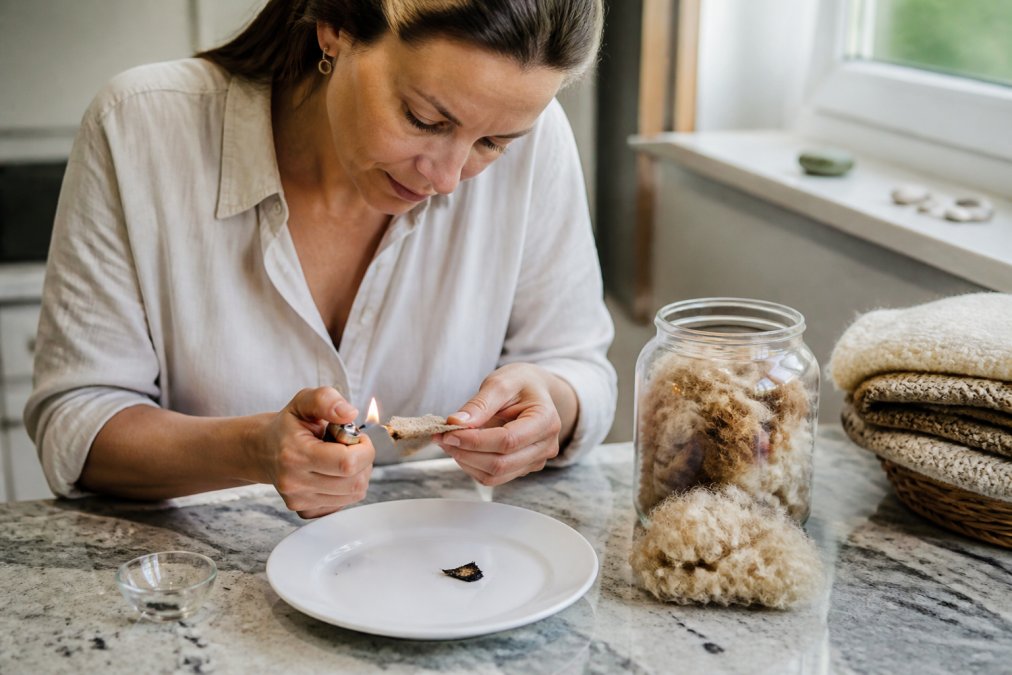
The burn test identifies fiber composition by how a sample ignites, smells, and behaves as ash. The Canadian Conservation Institute's fiber identification guidance standardized this method for textiles, and it works because plant and animal fibers burn in chemically distinct ways.
| Fiber Type | Burn Smell | Flame Behavior | Ash Residue |
|---|---|---|---|
| Cellulose (cotton, linen, hemp) | Burning paper | Steady, no melting | Soft grey ash |
| Protein (wool, silk, alpaca) | Burning hair | Self-extinguishes, curls | Crushable black bead |
| Synthetic (polyester, nylon) | Chemical, plastic | Melts and drips | Hard plastic bead |
Pull a few loose threads from a seam, hold them with tweezers over a fire-safe surface, and light one end. Never test a finished garment you plan to keep.
Sensory Testing for Home Users
Sensory testing is the practice of judging fiber content by feel, drape, and warmth before any destructive test. Rub the fabric against your inner wrist for ten seconds. Alpaca and silk feel cool and smooth with a soft halo; coarse wool pricks immediately. Squeeze a handful and release it: natural protein fibers spring back, while synthetics hold the crease.
Is Alpaca Wool Itchy for Sensitive Skin?
Alpaca wool is significantly less itchy than sheep's wool for most people with sensitive skin, because alpaca fiber has a smoother, longer scale structure and contains no lanolin. Standard wool's itch comes from two sources: coarse fiber diameter and lanolin, the waxy substance sheep produce that triggers contact dermatitis in some wearers. Alpaca has neither problem to the same degree, which is why it sits among the best natural fabrics for eczema and contact dermatitis.
If you react to wool but want that warmth, alpaca is the logical next step. Purely Alpaca has specialized in alpaca products since 2002, and the fiber's natural moisture-wicking and thermal regulation are reasons customers with skin sensitivities often choose alpaca.
Best Natural Fabrics for Eczema and Contact Dermatitis
The best natural fabrics for eczema are smooth, breathable protein and cellulose fibers worn over a tight weave: alpaca, silk, and fine cotton lead the list. Patch testing remains the standard procedure for diagnosing textile allergies, according to research published in ScienceDirect on textile-related allergies, because reactions usually trace to dyes and finishes rather than the fiber itself.
Ranked for reactive skin:
- Alpaca - smooth scales, no lanolin, excellent moisture management
- Silk - naturally smooth filament, minimal friction
- Organic cotton - pesticide-free, breathable, widely tolerated
- Linen - antimicrobial and cool, though the weave can feel rough at first
Wool and synthetics sit at the bottom. Synthetic polymers trap sweat against skin, which worsens flare-ups.
Weave Density: The Factor Most Shoppers Overlook
Weave density determines whether allergens reach your skin, and it matters more than the fiber name on the label. A porous weave traps dust mites and pollen inside the fabric structure, while a tight weave blocks allergen accumulation entirely. This is the contrarian point most "natural fiber" guides skip: FibreGuard's analysis of allergen trapping in textiles notes that a natural fiber in an open weave can perform worse for allergy sufferers than a tightly woven blend.
The Mechanism: Why Weave Beats Fiber Name
Dust mites are roughly 200 to 300 microns long, and their fecal pellets, the actual allergen, run about 10 to 20 microns. Pollen grains range from about 10 to 100 microns. A weave with gaps wider than those particles lets them pass straight through to the skin or into the filling. A tight weave physically blocks them at the surface, where they can be washed away.
This is why a loosely woven "100% organic cotton" coverlet can trigger more reactions than a tightly woven cotton-polyester blend. The fiber is natural; the barrier is not.
How to Check Weave Density at Home
- The window test. Hold the fabric up to a bright window. If you see a visible grid of light through the weave, allergens can settle in. If light passes through only as a diffuse glow, the weave is tight enough to act as a barrier.
- The thread-count check. For bedding, look for a thread count of at least 200. Below 200, the weave is typically too open to block mite allergen. Above 400, the benefit plateaus and the fabric may feel stiff.
- The backlight-and-finger test. Place a flashlight behind the fabric in a dark room and press a finger against the front. If you can see the finger's outline through the weave, it is too porous for allergy use.
- The hold-to-light comparison. Bring two candidate fabrics to the same window and compare them side by side. Relative density is easier to judge than absolute density.
Fabric-by-Fabric Weave Guidance
| Use Case | Minimum Weave Standard | Why |
|---|---|---|
| Pillow and mattress encasements | Tightly woven, 200+ thread count, zippered | Must block mite allergen from the filling |
| Sheets and pillowcases | 200-400 thread count | Balances barrier function with breathability |
| Upholstery and curtains | Tight weave, low pile | Loose weaves and deep pile trap pollen and dust |
| Clothing for contact dermatitis | Smooth, tight weave over the affected area | Reduces friction and dye transfer to skin |
Weave vs. Finish: What Actually Blocks Allergens
A tight weave blocks particulate allergens (dust mites, pollen, pet dander). It does not block chemical allergens, those come from dyes and finishes, which is why a tightly woven fabric with a reactive dye can still trigger contact dermatitis. Use weave density for respiratory allergens and certification for chemical ones. The two checks are complementary, not interchangeable.
Certifications and Red Flags: What Hypoallergenic Natural Fibers Actually Require
A certification is only useful if you know what it actually verifies. Most shoppers treat every seal as equivalent, which is exactly why vague "hypoallergenic" claims survive on shelves. The certifications below cover different stages of the supply chain, so a product can carry one and still fail another.
What Each Certification Actually Verifies
- GOTS (Global Organic Textile Standard), verifies organic fiber content from harvest through finished product, plus restrictions on dyes, finishes, and wastewater treatment. It covers cotton, linen, hemp, wool, silk, and alpaca. The Global Organic Textile Standard is the strongest single proof that a fiber was grown and processed without the chemical residues that trigger most textile reactions.
- OEKO-TEX Standard 100, tests the finished article for harmful substances (formaldehyde, heavy metals, azo dyes, pesticide residues) but does not require the fiber to be organic. A conventional cotton shirt can pass Standard 100. Look for the product class: Class I is for baby articles and carries the tightest limits.
- OEKO-TEX Made in Green, combines Standard 100 chemical testing with a traceable, socially responsible supply chain. Stricter than Standard 100 alone.
- USDA Organic, covers agricultural production of the raw fiber only. It says nothing about the dyes, softeners, or finishes applied after harvest, so a USDA Organic cotton tee can still carry a chemical finish.
- bluesign, a textile-processing standard focused on chemical input management and resource use. Common on performance and outdoor fabrics, less common on bedding.
How to Verify a Certification Is Real
A printed logo proves nothing. Every legitimate certification has a searchable database:
- Find the certification number or license number on the tag, hangtag, or product page, it is usually a multi-digit code near the logo.
- Enter it in the certifying body's public database (GOTS and OEKO-TEX both maintain searchable registries).
- Confirm the company name on the certificate matches the brand selling the product, not a supplier three steps up the chain.
- Check the expiry date. Certifications renew annually, and an expired number is a red flag.
If a brand cannot produce a certificate number on request, treat the claim as marketing.
Red Flags to Reject Outright
- "Hypoallergenic" with no certification body named
- Plant imagery on a label that lists no legal fiber name
- "Chemical-free" claims, which no textile can honestly make
- Blends that hide synthetics below the 5% "other fiber" threshold
- A certification logo with no number, no database entry, or an expired date
- "OEKO-TEX certified" language on a product that cannot name which OEKO-TEX standard applies
For bedding specifically, Purely Alpaca's Natural Alpaca Bed Pillow is filled with 100% alpaca fleece, which is naturally fire-resistant and hypoallergenic without chemical flame retardants.

Microplastics in Natural Blends: What to Watch For
"Natural blends" frequently contain 20% to 50% polyester, and those synthetic fractions shed microplastic fibers with every wash. Research from Cotton Incorporated's 2026 Global Lifestyle Monitor survey found that 83% of consumers consider cotton and other natural fibers safe for the environment, while fewer than half say the same about manmade fibers. That awareness is driving demand, but it also makes misleading blend labels more common.
To avoid shedding synthetics, check the percentage breakdown, not just the fiber names. A "cotton blend" that is 60% cotton and 40% polyester will shed plastic for its entire life. Wash natural-only garments in a mesh bag with cold water to reduce fiber loss, and use alpaca dryer balls in place of synthetic dryer sheets.

Conclusion
Reading a fiber label correctly takes thirty seconds, and it is the difference between clothing that calms reactive skin and clothing that quietly makes it worse. Between legal fiber names, the burn test, weave density, and GOTS verification, you now have four independent checks that no marketing claim can fake.
Purely Alpaca has been a family-owned source for naturally hypoallergenic alpaca since 2002, offering free shipping on orders of $100 or more and hassle-free returns if a piece does not suit your skin. Shop all at Purely Alpaca and start with fiber you can verify.
Frequently Asked Questions
How do I know if a fabric is natural or synthetic?
Check the label for legal fiber names like cotton, linen, silk, wool, or alpaca rather than vague terms like 'eco-blend.' A burn test helps too: cellulose fibers (cotton, linen) smell like burning paper and leave soft ash, while protein fibers (wool, silk) smell like burnt hair and form a crushable bead. Synthetic polymers melt and smell like plastic. For a definitive answer, microscopic examination distinguishes cellulose from protein fibers, per the Canadian Conservation Institute.
Is alpaca wool itchy for sensitive skin?
Alpaca fiber is generally less itchy than traditional sheep's wool for people with sensitive skin. The fiber has a smoother scale structure and lacks lanolin, a common irritant in sheep's wool. If you have eczema or contact dermatitis, choose tightly woven alpaca garments and wash them before wearing to remove any textile processing residues.
Does hypoallergenic mean the same thing as organic?
No. Hypoallergenic means a fabric is unlikely to trigger allergic reactions, while organic refers to how the fiber was grown and processed. A fabric can be organic but still cause irritation if it has a rough weave or chemical finishes. Look for GOTS (Global Organic Textile Standard) certification to verify both organic farming and safe processing. For allergen protection, weave density matters as much as the fiber itself, since porous weaves trap dust mites and pollen.
What is the best natural fabric for eczema-prone skin?
Cotton, alpaca, silk, and linen are among the best natural fabrics for eczema. Cotton is breathable and moisture-wicking; alpaca offers thermal regulation without the lanolin found in sheep's wool; silk is smooth and less likely to cause friction. Avoid rough wool weaves and synthetic blends that trap moisture. A tight weave reduces allergen trapping, so choose densely woven fabrics over loose knits. Always patch test a small area before wearing new fabrics extensively.