



Table of Contents
- Why Breathable Socks Matter for Cold Weather Activities
- Moisture-Wicking Winter Socks: How They Keep Feet Dry
- Alpaca Wool vs Merino Wool Socks: Which Breathes Better?
- How to Prevent Sweaty Feet in Winter
- Top Breathable Socks for Cold Weather Activities
- Sock-to-Footwear Compatibility: Getting the Fit Right
- Circulation and Medical Considerations for Cold Feet
- Conclusion
- Frequently Asked Questions
Last Updated: September 15, 2026
Why Breathable Socks Matter for Cold Weather Activities
Breathable socks for cold weather activities manage moisture, because wet feet lose heat roughly 25 times faster than dry ones, which is why a thick sock can leave you colder than a thin one.
Cold-weather comfort is a moisture problem disguised as a warmth problem. Your feet sweat during exertion, that sweat has nowhere to go inside a waterproof boot, and the insulation you paid for stops working. Wirecutter's sock testing and buying guidance identifies merino wool as a standout for temperature regulation, odor resistance, and breathability in cold conditions.
Below, we'll break down fiber choices, layering systems, and four specific socks that handle cold weather without turning your feet into a swamp.
Moisture-Wicking Winter Socks: How They Keep Feet Dry
Moisture-wicking winter socks move sweat away from your skin and spread it across the fabric surface, where it evaporates instead of pooling. Wicking efficiency depends on fiber type, knit density, and airflow: a dense knit with no ventilation zones traps vapor, while a lofted knit with breathable panels releases it.
The Two Stages of Moisture Transfer
Stage one, absorption and transport. The fiber pulls liquid sweat off your skin through capillary action and moves it toward the outer face of the sock. Hydrophilic fibers like wool and alpaca do this well; untreated polyester is hydrophobic and relies on knit structure instead.
Stage two, evaporation. Once moisture reaches the outer surface, it has to leave as vapor, which requires a path to escape. Inside a waterproof boot with a non-breathable membrane, that path is closed, the sock can wick perfectly and your foot still ends up wet.
A sock cannot out-wick a boot that traps vapor.
Why Fiber Blend Ratios Matter More Than Fiber Type
A sock labeled "merino" might be 38% merino and 62% nylon; one labeled "alpaca" might be 50% alpaca, 45% nylon, and 5% spandex. The blend ratio, not the headline fiber, determines performance.
- Wool or alpaca content above roughly 60% delivers strong moisture handling and temperature regulation, but the sock wears faster without reinforcement.
- Synthetic content of 30-45% (nylon, polyester, or a blend) adds abrasion resistance at the heel and toe and helps the sock hold its shape through repeated wash cycles.
- Spandex or Lycra at 2-5% provides the stretch recovery that keeps the sock from sagging inside a boot over a long day.
A 100% wool sock sounds premium but typically loses its loft, stretches out, and abrades at the heel within a season. A well-built blend outperforms it.
Knit Structure: The Variable Nobody Talks About
- Terry loop construction traps more air and absorbs more moisture, but adds bulk and dries slowly.
- Flat knit or jersey construction is thinner, dries faster, and transfers moisture more directly, but offers less cushioning.
- Zoned knits vary structure across the sock, denser at heel and toe, lofted at the instep, ribbed at the arch, the construction used in technical ski and hiking socks.
The Humidity Variable
Wicking performance varies with conditions. In dry cold, high-desert or mountain environments, evaporation is fast and a midweight sock handles sweat easily. In humid cold, coastal, lake-effect, or wet-snow conditions, the air is near saturation, evaporation slows, and the same sock can leave your feet damp.
In humid cold, choose a thinner sock with more synthetic content and a faster-drying structure; thicker insulation just holds more water against your skin.
Alpaca Wool vs Merino Wool Socks: Which Breathes Better?
Alpaca wool breathes better than merino for most cold-weather activities because its hollow fiber structure provides greater thermal regulation per unit of weight, while merino remains more widely available.
Alpaca fiber is naturally smooth and free of lanolin, the oil that makes conventional wool feel prickly against sensitive skin.
- Thermal regulation: Alpaca's hollow fibers trap air efficiently, so a midweight alpaca sock insulates like a heavier merino sock
- Moisture handling: Alpaca absorbs and releases moisture without feeling clammy, which matters during stop-start activity
- Durability: Alpaca holds up well, though it benefits from a nylon or Lycra blend for abrasion resistance in boots
- Skin comfort: Lanolin-free alpaca suits people who react to traditional wool
Merino's advantage is ubiquity and price; alpaca's is warmth-to-weight ratio and a softer hand. For sub-zero conditions and long days, alpaca has the edge.

How to Prevent Sweaty Feet in Winter
Preventing sweaty feet in winter comes down to managing three variables: sock material, layering, and boot ventilation. You cannot stop your feet from sweating. You can control where that moisture ends up.
Start with a sock that wicks rather than holds. Cotton absorbs moisture and keeps it against your skin; synthetics dry fast but develop odor and lose insulation when wet.
Liner Socks and Layering Systems
Liner socks paired with wool oversocks create the most effective warm, breathable microclimate for extreme cold, a system widely recommended by experienced cold-weather users on BuyItForLife community discussions. The liner moves moisture off the skin. The outer sock insulates and continues the transfer.
Two rules make layering work:
- The liner must fit snugly with no wrinkles, or it will cause blisters
- The outer sock needs enough room in the boot to loft, not compress
If your boots feel tight with two socks, the layering system will fail. Fit beats fiber every time.
Top Breathable Socks for Cold Weather Activities
The best breathable socks for cold weather activities balance insulation, moisture transfer, and fit. Here are four options from Purely Alpaca.
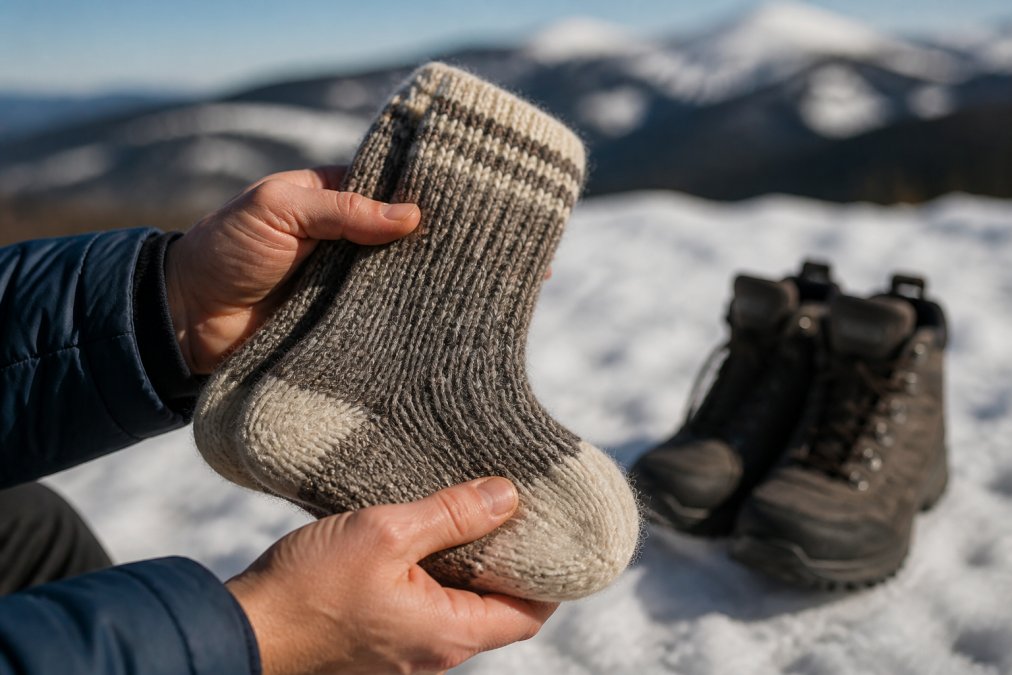
OutdoorAdventure Alpaca Sock: Heavyweight Warmth for Extreme Cold
The OutdoorAdventure is a heavyweight alpaca sock with a shock-absorbing cushion and a gentle calf fit that holds without pinching. Reinforced heel and toe, machine washable and dryable, unusual for this weight class. Best for outdoor work, hunting, motorcycling, and anyone with poor circulation. At $29.95.
Field Hiker Alpaca Socks: Lightweight Breathability for Active Days
A medium-weight classic hiking sock that works in trail shoes and around town. The 50% alpaca blend gives it a soft hand and reliable wicking without bulk.
Best for: hiking, walking, and everyday winter wear. At $24.95.
Dahlgren Summit Over-Calf Alpaca Sock: Technical Comfort for Skiing and Snowboarding
Technical comfort in smart, tonal colorways are found in the Dahlgren Summit Over the calf alpaca sock. A thick rugged sock, it is extra heavy for additional insulative warmth and padding. Over-the-calf length and ample thickness protect against the coldest and nastiest weather.
Best for: skiing, snowboarding, and cool-weather running. At $31.95.
Survival Over-the-Calf Sock: Maximum Coverage for Harsh Conditions
| Sock | Weight | Height | Best For | Price |
|---|---|---|---|---|
| OutdoorAdventure Alpaca Sock | Heavyweight | Tall crew | Extreme cold, poor circulation | $29.95 |
| Field Hiker Alpaca Socks | Medium | Boot | Active hiking, daily wear | $24.95 |
| Dahlgren Summit Over-Calf | Medium-heavy | Over-calf | Skiing, snowboarding | $31.95 |
| Survival Over-the-Calf | Midweight | Over-calf | Harsh weather, long days | $38.95 |
Sock-to-Footwear Compatibility: Getting the Fit Right
The Compression Problem
How to Size Boots Around Your Socks
Three Fit Checkpoints
Matching Sock Weight to Boot Type
The Liner Sock Variable
A Note on Boot Breathability
Circulation and Medical Considerations for Cold Feet
A few practical notes for cold-sensitive feet:
Conclusion
Frequently Asked Questions
What are the best socks to wear in cold weather?
Alpaca wool socks offer superior breathability and warmth compared to synthetics. The OutdoorAdventure Alpaca Sock from Purely Alpaca is a heavyweight option with cushioning and reinforced heel and toe. For milder cold, the Field Hiker Alpaca Socks provide medium-weight breathability. Merino wool is also popular, but alpaca fiber is softer, hypoallergenic, and naturally moisture-wicking. Look for socks with terry loop interiors and arch support for all-day comfort.
Do breathable socks keep your feet warmer in winter?
Yes. Breathable socks like those made from alpaca wool allow moisture vapor to escape, preventing sweat from cooling your feet. When feet stay dry, they retain heat more effectively. Alpaca fiber's hollow structure provides insulation without bulk, and its natural wicking properties move sweat away from the skin. This is why breathable socks outperform cotton or thick synthetic blends in cold weather activities.
How do I prevent sweaty feet in winter?
Prevent sweaty feet by choosing moisture-wicking socks like alpaca wool, which moves sweat away from your skin. Avoid cotton, which holds moisture. Wear liner socks under a wool oversock for a breathable microclimate. Ensure boots are not too tight to allow circulation. Rotate socks if you're active for hours, and let boots dry completely between wears. Purely Alpaca's Survival Sock uses terry loops and nylon for durability and moisture management.
What type of socks are the most breathable?
Socks made from alpaca wool or merino wool are the most breathable because their fibers wick moisture and regulate temperature. Alpaca is especially breathable due to its hollow fiber structure, which allows air to circulate. Synthetic blends with wicking channels, like the Dahlgren Summit Over-Calf Alpaca Sock, also perform well. Avoid cotton socks for cold weather activities, as they trap moisture and lose insulation when wet.