



Table of Contents
- Why Alpaca Socks Shrink and How to Tell If They're Salvageable
- How to Unshrink Alpaca Wool: The Soak-and-Stretch Method
- How to Stretch Shrunken Wool Socks Without Damaging the Fiber
- How to Wash Alpaca Socks So They Keep Their Shape
- How to Prevent Alpaca Socks from Shrinking: Care Habits That Work
- Drying Rack vs. Flat Drying: Which Method Protects Your Socks?
- Sizing and Fit Troubleshooting After Your Repair Attempt
- When to Repair and When to Replace Your Alpaca Socks
- Frequently Asked Questions
Last Updated: October 8, 2026
Why Alpaca Socks Shrink and How to Tell If They're Salvageable
Alpaca socks shrink because heat, water, and movement push the fibers together until they lock, which is why knowing how to repair shrunk alpaca socks matters. Alpaca fiber has a smooth cuticle and low scales, so it resists felting better than sheep's wool, but it is not immune. A hot wash or a hot dryer can still tighten the knit.

So before you toss a pair, run a quick check. Squeeze the sock. If it feels stiff and matted, the fibers have felted. If it still feels soft and springy but just looks small, you have a much better shot.
Here at Purely Alpaca, we have sold alpaca socks since 2002, and we hear this question every winter. The good news: most shrunken pairs can be helped. The bad news: not all of them.
The 'Point of No Return' Diagnostic: Felting vs. Simple Shrinking
Felting is permanent. Shrinking is often not. That is the whole diagnostic in one line.
Felting happens when protein fibers interlock. The scales on each fiber catch on its neighbors and never let go. You cannot undo it.
Simple shrinking happens when fibers relax and draw together, but the structure stays intact. This is reversible.
Run this test:
- Does the sock feel stiff, dense, or board-like?
- Can you see individual knit stitches, or is the surface a blur?
- Does it hold a crease when you fold it?
- Is it more than two sizes too small?
Two or more yes answers point to felting. One or none means the sock is likely salvageable.
How to Unshrink Alpaca Wool: The Soak-and-Stretch Method
To unshrink alpaca wool, soak the sock in lukewarm water with a small amount of hair conditioner, then stretch it gently while damp and let it air dry flat. Heat is the enemy here. Cold or lukewarm water plus slow, even tension is what relaxes the fiber.
The full process takes about 30 minutes of hands-on time plus drying. Here is how we would do it, with the sock-specific moves that a sweater-blocking guide will not tell you.
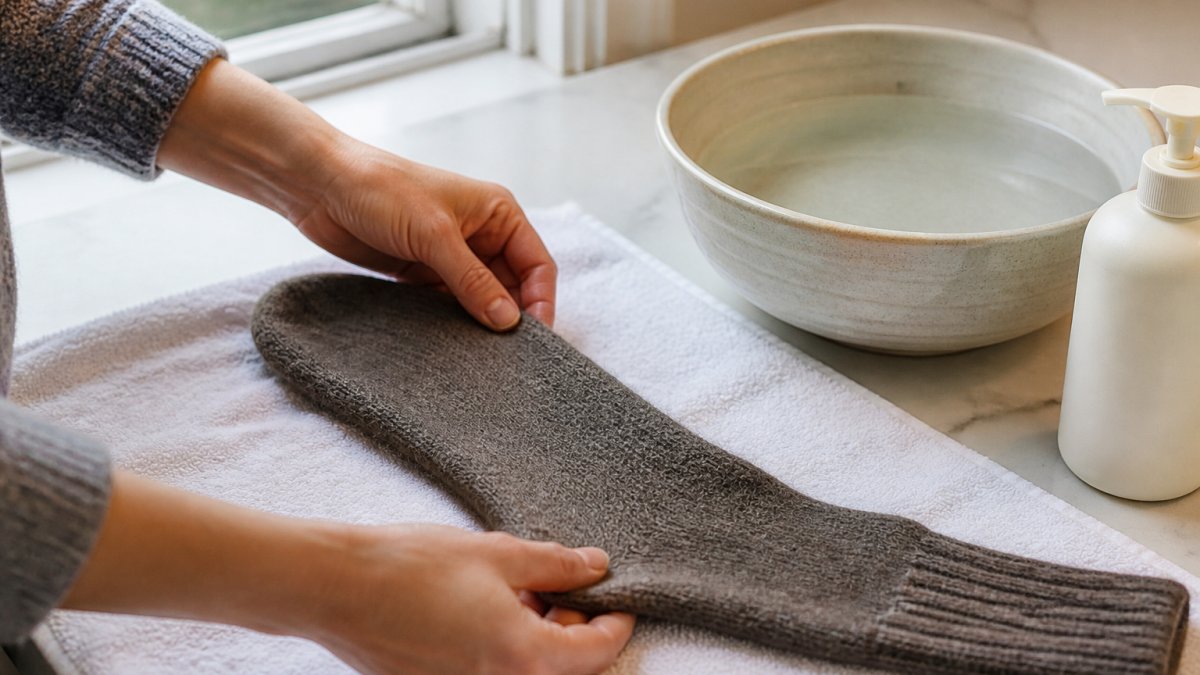
Step-by-Step: Soaking, Stretching, and Reshaping
Total time: 45 minutes plus drying Difficulty: Easy
What you'll need:
- Lukewarm water (roughly 85-95°F, comfortable to the touch, never hot)
- Hair conditioner or baby shampoo
- Two clean bath towels
- A flat drying surface (towel on a counter, blocking mat, or a rack used flat)
- Optional: a shoe tree, a rolled hand towel, or a sock blocker
Step 1: Fill a basin with lukewarm water. [Time: 2 minutes] Add a teaspoon of conditioner or baby shampoo. Swirl it in.
Step 2: Submerge the socks and soak. [Time: 20 minutes] Let them sit. Do not agitate. Agitation is what causes felting in the first place.
Step 3: Lift, do not wring. [Time: 1 minute] Squeeze water out gently with your hands. Never twist or wring a wet alpaca sock, the fibers are weakest when saturated.
Step 4: Roll in a towel. [Time: 3 minutes] Lay the sock flat on a towel, roll it up, and press down. The towel pulls out excess water.
Step 5: Stretch gently, length first, then width. [Time: 5 minutes] Work from the toe up. Pull in small, even increments. Hold each stretch for a few seconds. Two sock-specific rules apply here:
- The heel turn is the tightest zone. It has the densest stitch count, so it resists stretching the most. Pinch the heel between both thumbs and work it outward in small circles before you pull the leg.
- The ribbed cuff has memory. It will snap back faster than the body of the sock, so stretch it last and only slightly. Over-stretching the cuff is the fastest way to end up with a sock that fits the foot but slides down the ankle.
Step 6: Reshape and dry flat. [Time: 15 minutes setup] Lay the sock flat on a dry towel. Nudge it back into shape with your hands.
Step 7: Dry flat, not draped. [Time: 12-24 hours] This is where most repairs quietly fail.
Expected result: A sock that is noticeably longer and wider, though rarely back to its original size. Most pairs land one to one-and-a-half sizes closer to the original after a single round.
How to Stretch Shrunken Wool Socks Without Damaging the Fiber
Stretching shrunken wool socks works best when the fiber is damp and you apply steady, low tension rather than sharp pulls. Yanks break fibers. Slow pressure lets them slide.
Think of it like blocking a sweater. You are not forcing the yarn, you are guiding it.
A few rules that matter:
- Work in small increments, not one big pull
- Stretch length first, then width
- Use a shoe tree or a rolled towel inside the sock to hold shape while it dries
- Never stretch a dry alpaca sock
If the sock has a ribbed cuff, stretch that section last. Cuffs hold their memory longer than the body of the sock. Rushing this step is the most common mistake we see.

How to Wash Alpaca Socks So They Keep Their Shape
Washing alpaca socks correctly comes down to three things: cool water, mild soap, and no heat. Get those right and you will rarely need to repair shrunk alpaca socks at all.

The FTC's Care Labeling Rule requires manufacturers to list safe washing instructions on garment labels. Read them. They exist for a reason.
Superwarm Heavy Extreme Alpaca Socks →
Our routine:
- Turn socks inside out
- Use cool or lukewarm water
- Add a wool wash or baby shampoo
- Hand wash, or use a gentle machine cycle
- Skip the dryer unless the label says otherwise
- Lay flat to air dry
Some of our socks, like the Superwarm Heavy Extreme Alpaca Socks, are built to be machine washable and dryable. Even then, low heat is the safe setting.
How to Prevent Alpaca Socks from Shrinking: Care Habits That Work
Preventing shrinkage is easier than fixing it. Four habits cover almost every case.
- Wash cold. Heat is the number one cause of shrinkage.
- Skip the dryer. Air dry whenever you can.
- Avoid agitation. Hand wash or use a gentle cycle.
- Store flat. Hanging stretches the cuff over time.
A common mistake is treating alpaca like cotton. It is not. Alpaca is a protein fiber, closer to your own hair than to a plant fiber. Would you wash your hair in hot water and then tumble dry it? Exactly.
The American Cleaning Institute's fabric care guidance makes the same point about protein fibers: gentle handling and cool water preserve them.
Drying Rack vs. Flat Drying: Which Method Protects Your Socks?
Flat drying wins for alpaca socks. A drying rack lets gravity pull the wet fiber downward, which stretches cuffs and distorts shape. Flat drying keeps the sock in its natural form while it dries.
Here is the comparison:
| Method | Effect on Alpaca | Best For |
|---|---|---|
| Flat drying on a towel | Keeps shape, even drying | Alpaca socks, always |
| Drying rack (draped) | Can stretch cuffs and toes | Sturdy cotton items |
| Hanging by the toe | Distorts the whole sock | Not recommended |
| Tumble dry low | Risk of shrinkage | Only if the label allows |
If you only have a rack, lay the sock flat across the bars instead of draping it. That gets you most of the benefit of flat drying without buying anything new.
Sizing and Fit Troubleshooting After Your Repair Attempt
Your repaired sock may not return to its original size. That is normal. What is not normal, and what most guides skip, is that socks rarely shrink evenly.
Still too small after two attempts? The fiber has likely felted. Stop stretching. You risk tearing the knit.
Foot fits but the cuff slides down? This is the most common post-repair complaint, and it is a ribbing problem, not a fiber problem.
Heel is tight but the leg is fine? The heel turn is the densest knit zone on the sock, so it is the last part to relax.
Toe seam feels puckered or lumpy? The seam is usually a different fiber blend or a tighter stitch than the body.
Too long or too wide? Soak it again briefly and reshape it smaller. Alpaca holds the shape it dries in, so this is genuinely reversible.
Sock fits but feels stiff or scratchy? That is a sign the fiber is still tight, not felted.
If the fit never comes back, it may be time for a fresh pair. Our OutdoorAdventure Alpaca Sock has a cushioned interior and reinforced heel and toes, which helps it hold shape through repeated washing.
When to Repair and When to Replace Your Alpaca Socks
Repair makes sense when the sock is soft, the knit is intact, and the size gap is small. Replace it when the fiber has felted, the heel has worn thin, or holes have appeared.
Use this rule of thumb. If two soak-and-stretch rounds do not help, the sock is done. More effort will not bring it back.
Quality alpaca socks are built to last. Our Field Hiker Alpaca Socks and Classic Alpaca Socks both hold up well with proper care. Treat them right and you will get many winters out of a single pair.
For more on fiber care and how wool behaves under heat and water, the USDA's natural fiber resources are a solid reference.
Frequently Asked Questions
Can you unshrink alpaca socks?
Yes, if the fibers are relaxed and not permanently felted. Soak the socks in lukewarm water with a small amount of hair conditioner or baby shampoo for 15 to 30 minutes. Gently stretch them back to shape, then lay flat to air dry. If the fibers have locked together through felting, the sock may not return to its original size. Check by trying to separate the fibers gently; if they won't move, repair may not be possible.
How do you stretch shrunken alpaca socks?
After soaking in lukewarm water with conditioner, lay the sock on a towel and gently stretch it lengthwise and widthwise using even tension. Work in small sections rather than pulling hard in one spot. Repeat the soak-and-stretch process if needed. Always air dry flat to lock in the new shape.
How do you wash alpaca socks without shrinking them?
Hand wash in lukewarm water with a gentle wool wash or baby shampoo. Avoid hot water, which causes thermal shock and fiber contraction. Never wring or twist the socks; instead, press the water out gently and roll them in a towel to remove excess moisture. Some alpaca socks, like Purely Alpaca's Superwarm and OutdoorAdventure styles, are machine washable and dryable, but always check the care label first.
Can felted alpaca socks be restored?
Felted fibers have permanently interlocked, so full restoration is unlikely. You can try soaking in lukewarm water with hair conditioner and gently stretching, but results vary. If the socks remain stiff and small after one or two attempts, they are probably beyond repair for wearing. You can still repurpose them as cozy liners or craft material rather than throwing them away.
Shrinking is frustrating, but it is rarely the end of a good pair of socks. With cool water, gentle stretching, and flat drying, most pairs come back to a wearable size. When a pair is truly past saving, Purely Alpaca can help you find a replacement built to last. Our socks are made from high-quality alpaca fiber, designed for warmth and comfort, and backed by a family business that has served customers since 2002. Shop all and find your next favorite pair.