





Table of Contents
- Alpaca Wool vs Cashmere for Travel Clothing: The Short Answer
- Head-to-Head Comparison: Alpaca Wool vs Cashmere
- Durability of Alpaca vs Cashmere: Pilling, Tensile Strength, and Garment Longevity
- Benefits of Alpaca Wool for Travel: Moisture-Wicking, Breathability, and Odor Resistance
- Performance in Humidity vs Arid Climates: What Travelers Should Know
- Alpaca Wool Care Instructions for Travel
- Cost, Ethical Sourcing, and What to Pack
- Conclusion
- Frequently Asked Questions
Last Updated: October 6, 2026
Alpaca Wool vs Cashmere for Travel Clothing: The Short Answer
For most travelers, alpaca wool outperforms cashmere on the metrics that matter in a suitcase: durability, moisture handling, and odor resistance. Cashmere still wins on pure softness and packability. That is the honest trade-off, and it is the one most buying guides skip past.
This guide from Purely Alpaca breaks down the fiber science, the real-world travel performance, and the care routines behind both materials.
Alpaca wool is a natural fiber harvested from alpacas, prized for its thermal insulation, moisture-wicking properties, and smooth, hollow fiber structure. Cashmere is a fine down fiber combed from cashmere goats, valued for its softness and lightweight warmth. Both are luxury textiles.
Head-to-Head Comparison: Alpaca Wool vs Cashmere
The core difference comes down to fiber structure. Alpaca fibers are hollow, which gives them insulating properties without much weight. Cashmere fibers are finer in diameter, which is why cashmere feels softer against skin. That softness comes with a durability cost.
| Feature | Alpaca Wool | Cashmere |
|---|---|---|
| Fiber structure | Hollow, semi-scaled | Fine, smooth-scaled |
| Warmth-to-weight | High | High |
| Pilling resistance | Stronger | Weaker |
| Moisture handling | Wicks well, stays warm when damp | Wicks, but loses loft faster |
| Hypoallergenic | Lanolin-free, low prickle | Generally low irritant |
| Best for | Active travel, cold and damp climates | Light packing, dry cold, dressy use |
Fiber Structure, Softness, and Hypoallergenic Properties
Alpaca fiber has a wider diameter range than cashmere, but it lacks the lanolin found in sheep wool. That matters if your skin reacts to traditional wool. Many travelers with sensitive skin report that alpaca feels smooth rather than prickly, because the fiber's scale structure sits flatter against the skin.
Cashmere is finer and softer to the touch, which is why it dominates the luxury knitwear market. The trade-off: those fine fibers are more fragile. A common mistake is assuming softness equals quality. In practice, the softest fiber is often the one that pills first.
Warmth-to-Weight Ratio and Thermal Insulation
Both fibers deliver strong thermal insulation for their weight. Alpaca tends to hold its loft better over time, which means its insulating properties stay consistent across seasons. Cashmere has an excellent warmth-to-weight ratio when new, but thin spots develop faster with regular wear.
For travelers packing a capsule wardrobe, this matters. A garment that keeps its loft is a garment you can rely on for a multi-week trip without a backup layer.
Durability of Alpaca vs Cashmere: Pilling, Tensile Strength, and Garment Longevity
Alpaca wins the durability comparison for travel. The Ridge Merino fiber comparison notes that 100% alpaca garments can stretch less than merino and are not always durable in pure form, which is why most quality alpaca travel pieces blend in a small percentage of nylon or elastic for structural support.

Cashmere's fine fibers break down faster under friction. Pilling resistance is weaker, and tensile strength is lower. A cashmere sweater worn under a backpack strap for a week will show wear. An alpaca blend in the same conditions holds up noticeably better.
Garment longevity comes down to two things: fiber integrity and construction. Look for reinforced heels, toes, and seams. Look for dense knit construction. Those details matter more than the fiber label alone.
Benefits of Alpaca Wool for Travel: Moisture-Wicking, Breathability, and Odor Resistance
The benefits of alpaca wool for travel start with moisture management. Alpaca fiber is naturally hydrophobic on the surface and hydrophilic in the core, which means it pushes moisture away from skin while absorbing some vapor.
Odor resistance is the underrated advantage. Alpaca fiber is naturally antimicrobial, so it resists the bacteria that cause smell.
For hiking and cold-weather travel, we recommend the BACKPACA Lightweight Hiker Alpaca Ankle Socks.

For everyday wear and light hiking, the 100% Alpaca American Traveler Socks are our top pick. They are knit at a century-old mill in Pennsylvania and naturally odor resistant.
Performance in Humidity vs Arid Climates: What Travelers Should Know
Most alpaca vs cashmere articles are written for a Vermont winter and stop there. That is a problem, because the fiber that wins in a dry cold snap is not always the fiber that wins in a Bangkok downpour or a Tucson summer. Here is how each material actually behaves across the climate range travelers encounter.
High humidity (coastal tropics, monsoon season, summer in the Southeast)
Alpaca's hollow medullated core is the reason it performs here. The fiber's cortex absorbs water vapor into the interior while the scaled outer surface stays relatively hydrophobic, so sweat vapor moves off the skin and into the fiber rather than pooling against it.
Cashmere behaves differently. Its fine, smooth-scaled fibers have less internal structure to trap vapor, so moisture tends to sit on the surface and the garment loses loft, and therefore warmth, faster once it gets damp. In humid heat, cashmere reads as heavy and clingy. It is a dry-cold fiber, not a tropical one.
Arid cold (high desert, mountain West, dry winter air)
This is cashmere's home turf. With low ambient humidity, static is less of an issue, fibers stay lofty, and cashmere's softness is at its best. Alpaca also performs well here, its temperature regulation does not depend on ambient moisture, but the softness gap narrows and cashmere's packability advantage becomes more relevant.
100% Alpaca American Traveler Socks →
The mixed-climate trip
Most real itineraries are not one climate. A ten-day trip that starts in a dry mountain town and ends on a humid coast will punish any single-fiber packing strategy. The answer is not to pick a winner; it is to layer.
A concrete capsule for a two-week mixed-climate trip:
- Two alpaca base-layer socks (rotate, air-dry overnight)
- One alpaca or alpaca-blend mid-layer crew or hoodie
- One cashmere or fine-alpaca scarf for dressy evenings and flights
- One packable windproof shell
- One lightweight alpaca beanie for cold mornings
That is five pieces that cover humid heat, arid cold, and the transitions in between, and it weighs less than a single heavy wool coat.
Alpaca Wool Care Instructions for Travel
The reason care matters more for travel clothing than for a sweater that lives in a closet is simple: on the road, you are washing in a hotel sink, drying in a bathroom, and wearing the same piece multiple days in a row. Both alpaca and cashmere can handle that, but they need different handling, and the failure modes are not the same.

Sink washing, step by step
- Fill a clean sink with cool or room-temperature water, never hot, which can felt the fiber.
- Add a small amount of mild soap or a pH-neutral travel wash. A dollop of gentle shampoo works in a pinch.
- Submerge the garment and let it soak for 5-10 minutes. Do not agitate or scrub.
- Press the water through the fabric with open palms. Never wring or twist.
- Drain, then press the garment against the sink wall to release excess water.
- Roll the garment in a dry towel and press to absorb remaining moisture.
- Lay flat to air dry, reshaping gently. Keep it away from direct heat, radiators, and hair dryers.
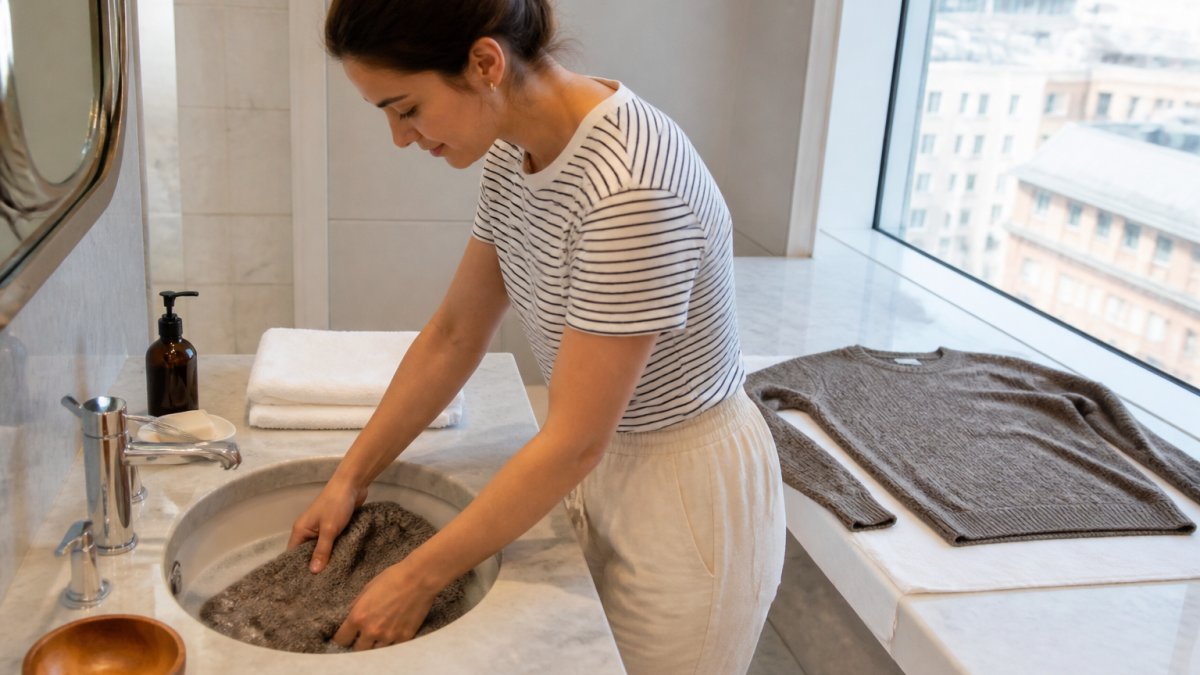
How alpaca and cashmere care differ on the road
Alpaca is the more forgiving of the two. Its fiber structure resists pilling and holds loft through repeated washing. It also dries reasonably fast when laid flat with good airflow, often overnight in a hotel room with the bathroom fan running.
Cashmere is less forgiving. Its fine fibers are more prone to felting if the water is too warm or the soap too alkaline, and it loses shape faster if it is hung or stretched while wet. Cashmere also pills more readily under friction, so a scarf or sweater that rubs against a backpack strap or seatbelt will show wear within a trip.
Odor management between washes
This is where alpaca earns its keep for travelers trying to stretch laundry days. Alpaca fiber is naturally antimicrobial, which means it resists the odor-causing bacteria that build up in synthetic and even some wool garments. In practice, most travelers find they can wear an alpaca base layer or a pair of alpaca socks for several days between washes without noticeable odor, a meaningful advantage on a long trip where laundry access is limited.
Cashmere does not offer the same odor resistance. It will start to hold smell sooner, especially in humid conditions.
Quick rules that apply to both fibers
- Turn garments inside out before washing
- Use cool water, never hot
- Skip fabric softener, it coats the fiber and reduces wicking
- Air dry flat, away from direct heat
- Store folded, not hung, for long trips
- Rotate between two pieces rather than wearing one every day
Cost, Ethical Sourcing, and What to Pack
Cost-benefit analysis for travelers favors alpaca over the long run. Cashmere often costs more upfront, and its shorter lifespan means more replacements. Alpaca blends cost less per wear because they hold up longer.
Ethical sourcing matters for both fibers. Alpaca is shorn annually without harm to the animal, and reputable sellers can trace fiber back to farms. At Purely Alpaca, we have sourced alpaca fiber since 2002 as a family-owned business, and our BACKPACA line uses fiber pooled from farms across the country.
What to pack for a cold-weather trip:
- Two alpaca base-layer socks
- One alpaca or alpaca-blend mid-layer
- One cashmere or alpaca scarf for dressy evenings
- One windproof shell
That is a travel capsule that handles humidity, arid cold, and everything between.
Conclusion
The real challenge with travel clothing is not choosing between luxury and performance. It is finding a fiber that delivers both without falling apart mid-trip. Alpaca does that better than cashmere for most itineraries, especially when dampness, odor, and durability are on the line.
Purely Alpaca has offered naturally warm, hypoallergenic alpaca clothing since 2002. Our catalog includes free shipping on orders of $100 or more, hassle-free returns, and a range of styles for men and women. If you want travel pieces that hold their shape and their warmth, shop all our alpaca travel essentials and pack with confidence.
Frequently Asked Questions
Is alpaca wool warmer than cashmere?
Alpaca wool has a hollow fiber structure that traps air for thermal insulation, and it tends to feel warmer at a similar weight than cashmere. Cashmere is lighter and less bulky, which some travelers prefer for packability. For extreme cold or multi-climate trips, alpaca's warmth-to-weight ratio makes it a strong choice. For mild weather and minimal packing, cashmere's lighter feel may win.
Which is more durable for travel: alpaca wool or cashmere?
Alpaca wool generally holds up better under repeated wear and packing than cashmere. Cashmere fibers are shorter and finer, so they pill more easily with friction from backpacks, seatbelts, and luggage. Alpaca has greater tensile strength and resists pilling longer. That said, fit and construction still matter. Look for reinforced heels, toes, and seams on travel socks.
Does alpaca wool pill as much as cashmere?
No. Alpaca wool resists pilling better than cashmere because its fibers are longer and stronger. Cashmere's short fibers work loose with friction and form pills on sweaters, scarves, and socks. Alpaca's fiber integrity holds up through repeated wear and washing. To further reduce pilling, turn garments inside out before washing, use gentle cycles, and avoid high-heat drying.
Is alpaca wool hypoallergenic for sensitive skin?
Alpaca wool is naturally hypoallergenic because it contains no lanolin, the oil in sheep's wool that triggers itching and irritation for many people. Its smoother, less scaly fiber surface also reduces friction against skin. Travelers with eczema or sensitive skin often find alpaca comfortable where regular wool is not. If you are highly reactive, start with a small item like socks or a scarf to test tolerance before committing to a full garment.